
This post may contain affiliate links.
Come along as we dive into the details of Intrepid’s 11-day tour, “Kazakhstan and Kyrgyzstan Adventure”, as experienced in August 2026. If you missed my first article, “Why Visit Kazakhstan and Kyrgyzstan?” as an introduction to the region, it’s history and geography, Be sure to check it out HERE.
Why join a group tour?
While I have always enjoyed the challenge and independence of self-organized solo travel, I found joining a small group tour was a great way to adventure in Central Asia, an unfamiliar region. The camaraderie of the group – intellectually curious, active and well-traveled folks, mixed with seamless organization by Intrepid, a great local tour leader, and a thoughtful itinerary allowed us to focus on enjoying the destination, rather than worrying about border crossings, accommodations, transport, and language barriers.
Transportation details
This trip departs from Astana, Kazakhstan and ends in Bishkek, Kyrgyzstan. The tour makes a land crossing at the Kazakhstan/Kyrgyzstan border. Flights from Astana to Turkestan, and train passage from Turkestan to Almaty during the trip are included. Individuals are responsible for their personal flights into Astana, and departing from Bishkek.
What to expect
The steppe, canyons, mountains and lakes would all come later in our tour. To begin, understanding history and culture to frame the land was necessary. That’s why this tour started in Astana, Kazakhstan’s capital, then linked by air to Turkestan, the center of the Silk Road trading route, before taking a night train to Almaty. It was a history and cultural immersion up front. From Almaty we would travel by van for the balance of the trip, making a switch at the border to Kyrgyzstan, and ending in Bishkek.
Along the way, visits to museums, petroglyphs, ruins, mausoleums, mosques, and cathedrals layered in the story of these lands. But there was also a healthy dose of hiking built in throughout the tour, most heavily weighted towards the middle and end. It’s important to note the thoughtful organization of this 11-day tour. Intrepid understands that the curious, well educated traveler wants to expand their knowledge, while also packing in a lot of active adventure.
Intrepid Kazakhstan and Kyrgyzstan adventure FAQs
The 11-day tour starts in Astana, Kazakhstan, and ends in Bishkek, Kyrgyzstan. It includes a flight from Astana to Turkestan, an overnight train to Almaty, and van travel for the rest of the trip, with a land border crossing into Kyrgyzstan. Travelers book their own flights into Astana and out of Bishkek.
The Kegen border crossing is a scenic, remote land route from southeastern Kazakhstan to Karakol, Kyrgyzstan. Foreigners and groups usually walk through security, where guards from each country stamp passports and scan luggage, then take new transport on the other side. On an organized tour, a second van and driver wait for you after the crossing.
Intrepid groups in Central Asia tend to be active, well-traveled professionals looking for adventure. On this 11-day tour, the 12 travelers came from the UK, Australia, Canada and the US. Ages ranged from late 20s to early 60s, with most in their mid-to-late 30s, which the tour leader said is a typical mix.
Day 1: Astana
Our group met for dinner in Astana the evening of day one, where we were introduced to our tour leader and 11 other fun loving travelers. Intrepid tours appeal to a broad age demographic. Our group ranged from late 20s to early 60s, with the majority in their mid to late 30s. All were well educated professionals, well-traveled, and united in their pursuit of adventure travel. Although many different nationalities join Intrepid group tours, I was told the composition of our group, from the UK, Australia, USA and Canada, was quite typical.
Day 2: Astana
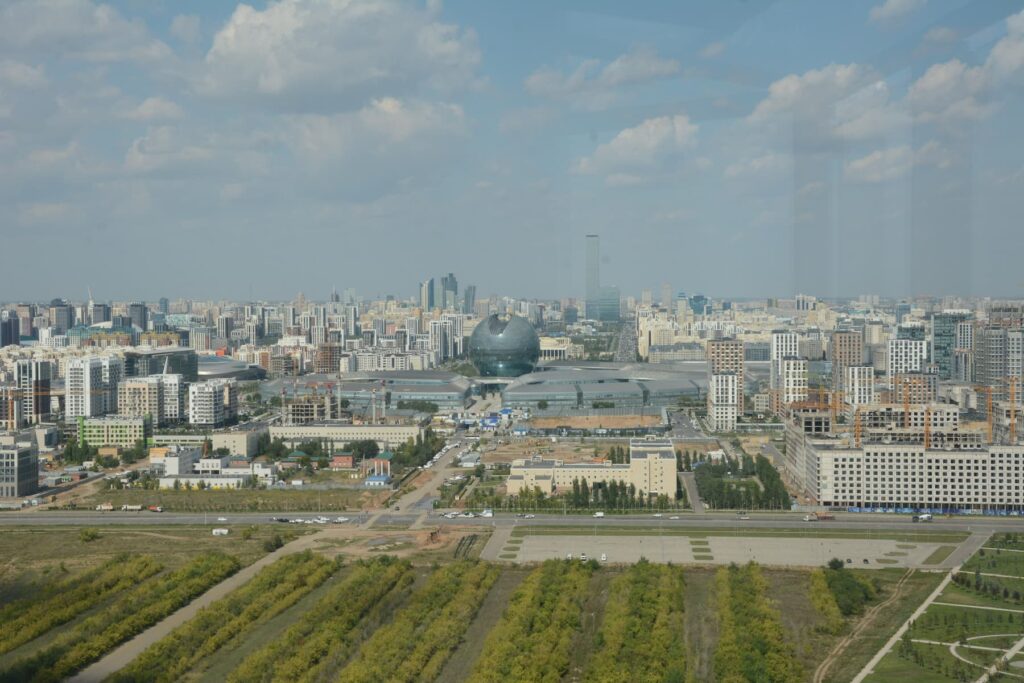
Astana is a purpose-built city which became the capital of Kazakhstan. With meticulously planned city streets and architecture, this modern metropolis was designed by leading Japanese architect Kisho Kurokawa, who won first prize in a competition against other world-renowned architects. Now, it’s one of the youngest cities in Central Asia.
The morning of day two, we visited a renowned local jeweler in his workshop to learn about his craft, then joined a city tour around some of the most impressive designs of this new city.
Construction has exploded in Astana, after becoming the capital in 1997. Since then the growth of unique architecture rivals Singapore or Dubai. Upon first glance, I felt the city and its jarring placement in the vast steppe parallel the curated existence of Vegas in the Mojave Desert. Grand in scale, mostly new, and impeccably designed. This young, forward-thinking vibe has attracted Kazakhstan’s ambitious, talented youth. Astana is also remarkably pedestrian friendly with its elevated walkways and community spaces. The transplanted trees lining the streets will need another generation of growth to give the city the mature green space that Almaty has though.
Palace of Peace and Reconciliation
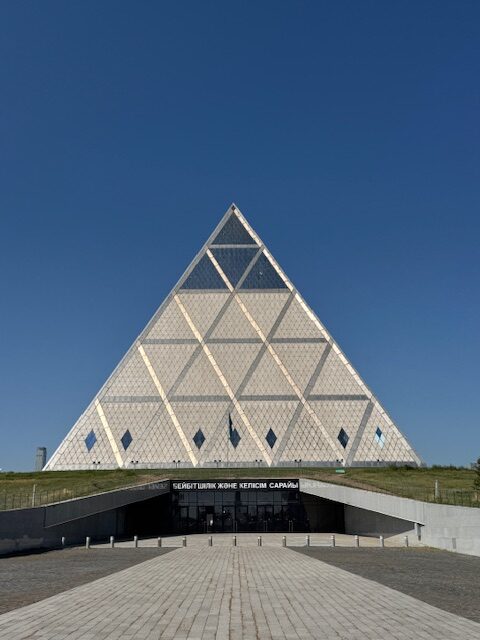
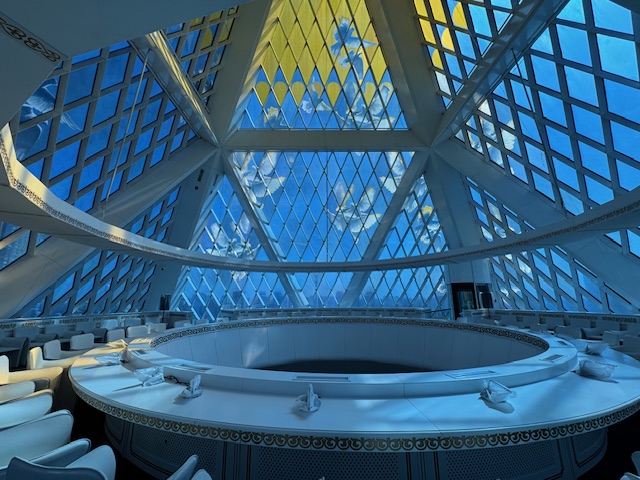
The Palace of Peace and Reconciliation is at Astana’s symbolic center. It’s a striking piece of architecture. The glass pyramid design is a conference and meeting space, but it was built as a symbol of tolerance and independence, to help reconcile with the past, and be a symbol for moving forward. The gravity defying 60 degree angled elevator is unique, with only the Eiffel Tower and Pyramid Hotel in Vegas, sharing this distinction.
Nur-Astana Mosque
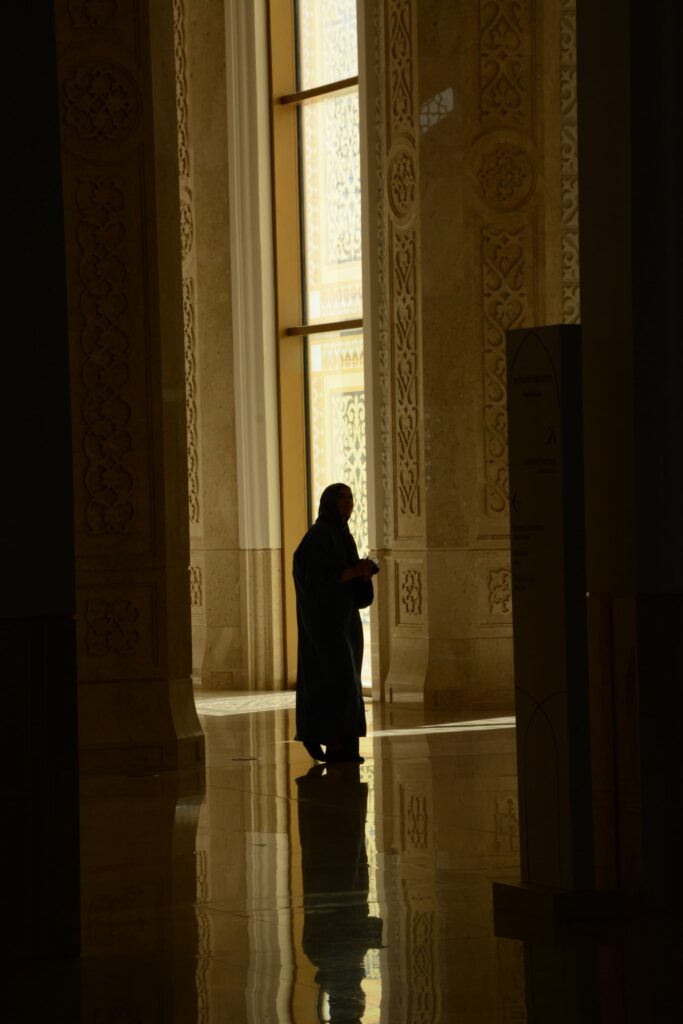
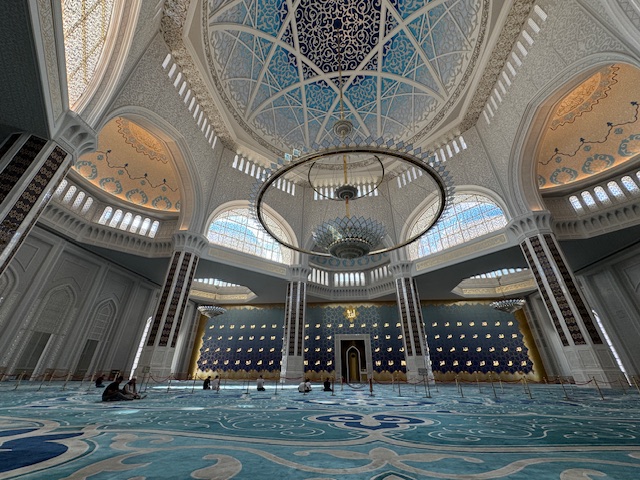
Astana is home to Nur-Astana Mosque, the biggest mosque in Central Asia, and the third largest in the world. With a capacity for 7,000 worshipers, which includes 5,000 inside and an additional 2,000 outside, it was an impressive site to visit.
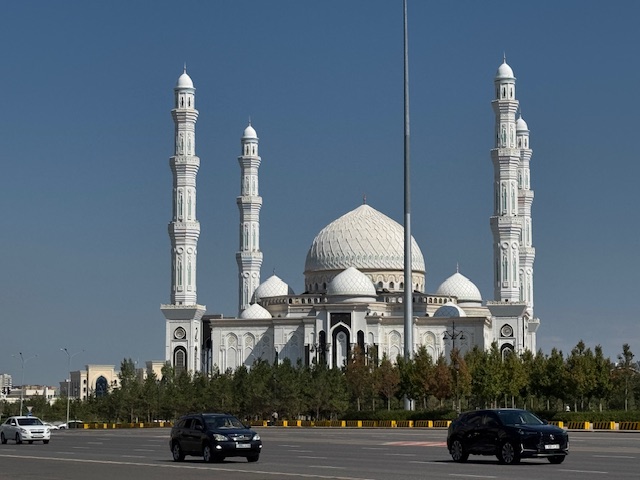
As guests, we were respectful of the Islamic faith, removing footwear, and women covering heads, shoulders and legs above the knee. We immediately felt the sense of calm throughout the corridors, central outdoor space, and in the prayer hall.
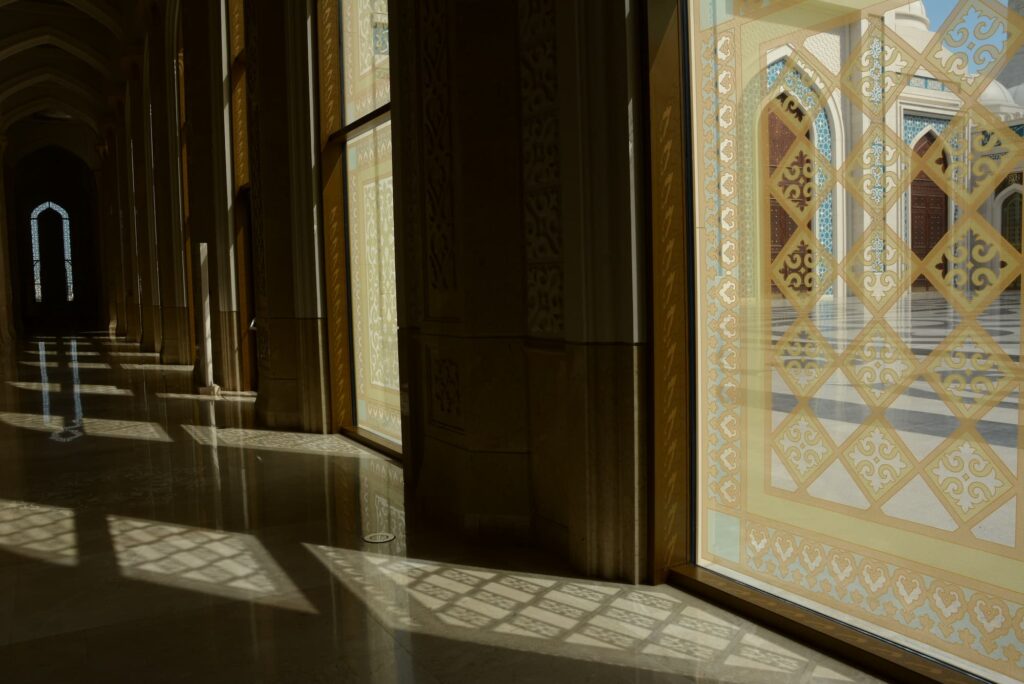
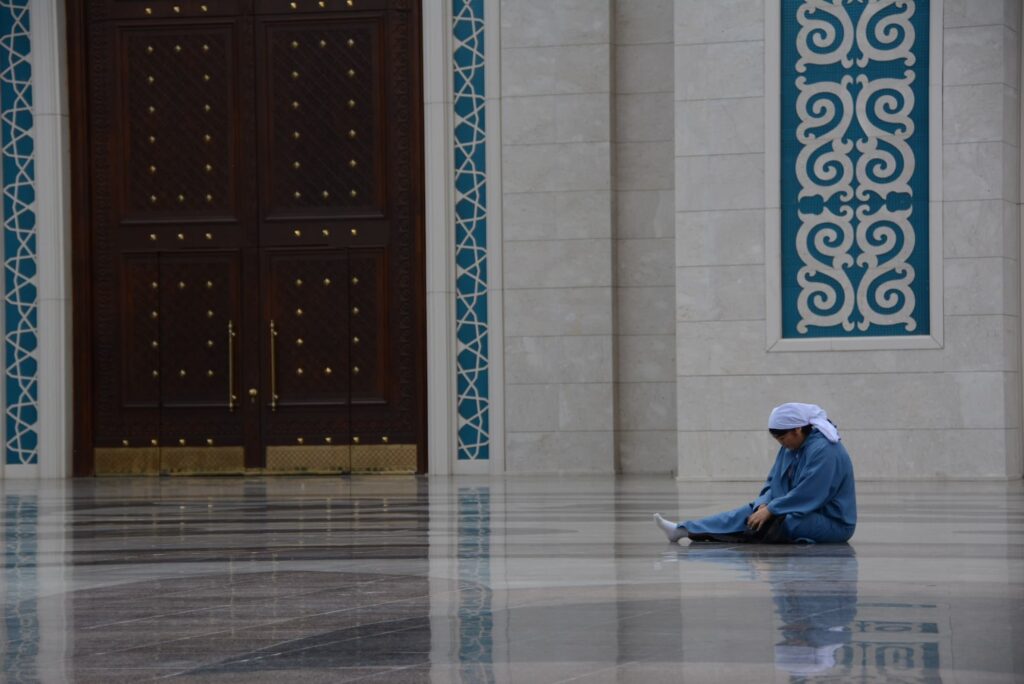
Of note, the chandelier hanging from the center of the main dome, contains 3.5 million pieces of glass. And the 17,000 square meter handmade carpet inside the prayer hall, was made from New Zealand wool, taken to Delhi to construct.
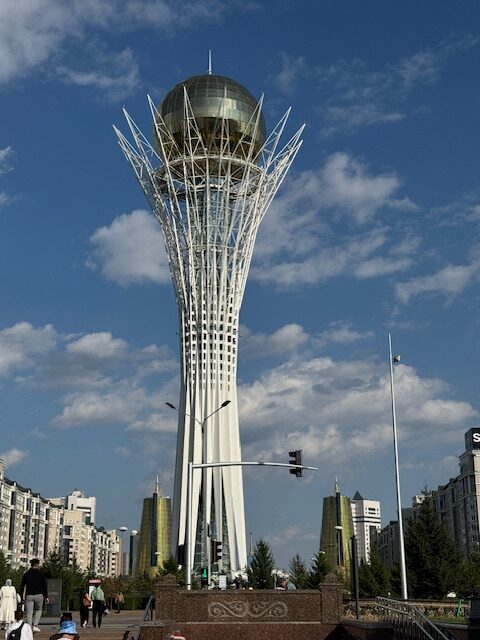
Baiterek Tower
The Baiterek Tower is one of the most recognizable landmarks in Kazakhstan. The structure is both monument and observation tower.
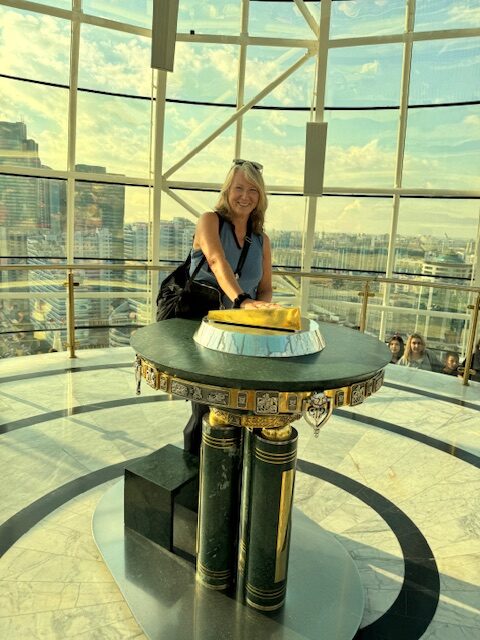
A few of us visited the top golden sphere near sunset to place our hand for good luck, on the gilded gold hand imprint belonging to the country’s first president Nursultan Nazarbayev. In doing so we joined many other Kazakh families, sharing in the ritual. Their country pride, and wishes for good fortune, were palpable as they placed their hand on the imprint.
Kazakhstan National Museum
Astana is home to the Kazakhstan National Museum, housing well documented artifacts and history. This was an optional afternoon destination on our tour, so several of us took advantage of the opportunity to expand our learning. It was also a great excuse to experience the state of the art above ground rail transit system in Astana, in getting there.
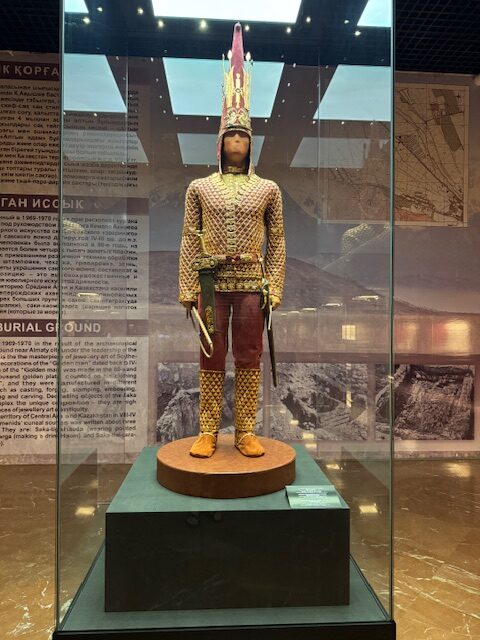
The museum is ambitious in chronicling the history of Kazakhstan from the Stone Age to Soviet rule, and achievements as an independent country in the 21st century. The Golden Man exhibit, an iconic 3rd-4th century BC archaeological find of a Saka warrior, buried in gold adornment attire was spectacular. Discovered 50km east of Almaty in 1969 by Soviet archaeologists, the Golden Man is a defining national symbol of the country’s independence and heritage.
Astana at night
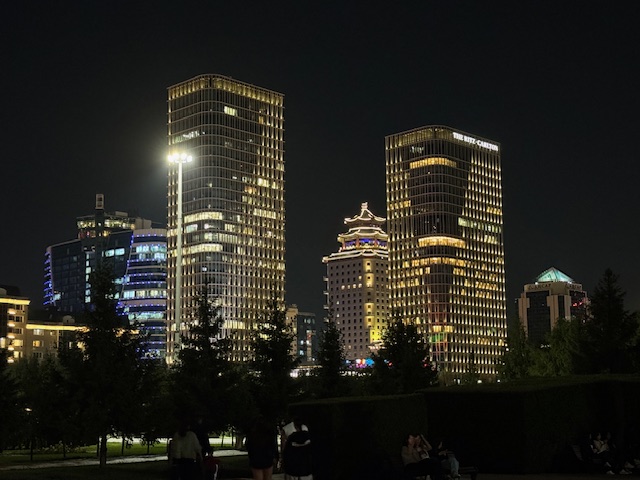
The night time illuminated architecture brings an even more futuristic feel to the city, complimented with the youthful vibe of street musicians. Walking blocks of pedestrian pathways and public spaces meticulously created with stone pavers, is a delight at night in Astana. In the summer pedestrian areas are filled with locals, and the police presence makes the city feel incredibly safe.
It’s worth noting that Astana can be cooler than Almaty, due to its northern location. And the weather changes dramatically with the seasons. Astana sees temperature hitting 35C in the summer, plummeting to -35C in the winter.
Day 3 & 4: Turkestan
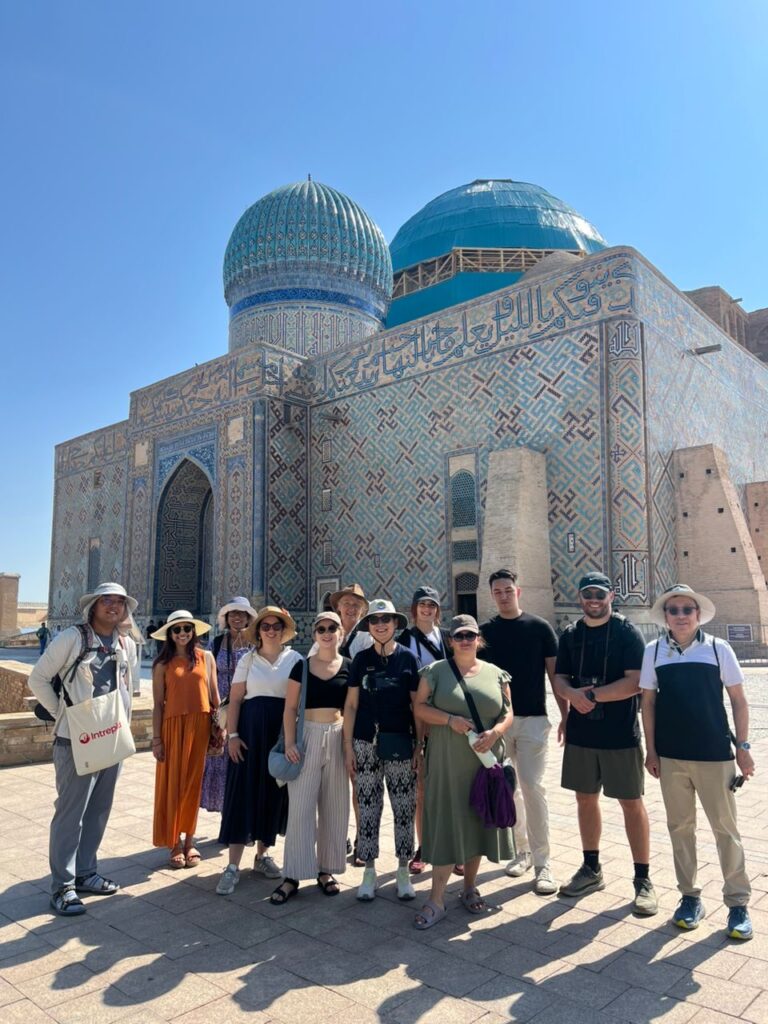
On the third morning of our tour, we took a flight from Astana to Turkestan, the historic centre of Kazakhstan, and the location of more relics and cultural sites than any other place in the country. Turkestan is a Silk Road Town, and home to Kazakhstan’s greatest architectural monument, the mausoleum of Khoja Akhmed Yasawi, a revered mystic and poet. Turkestan was an important trade and religious center when Yasawi arrived in the 12th century, and the mausoleum attracted Sufi faithful. It’s said that three visits here are equal to one visit to Mecca.
While remaining an important pilgrimage site, the new Caravan Serai, a complex recently built to model ancient Silk Road trade centers, is flanked by mall style commerce and canal gondoliers. It was a bit “theme park” in its interpretation of a modern Silk Road, but we never-the-less enjoyed the evening on the water presentation of Kazakhstan’s history acted out in a spectacular sound and light show. Despite my initial reluctance, the high-tech Samruk Flying Theatre IMAX show was also worthy, as an aerial journey through Kazakhstan. It was an all sensory experience belted into tilting airborne seats, with wind in our hair and the taste of mist in the air, soaring through history like an eagle over Kazakhstan’s remarkable landmarks.
While an educational experience, I did find the new Caravan Serai a bit jarring with such blatant commercialization, and pilgrims taking selfies a stone’s throw of the mausoleum itself. But I believe this is more symbolic of an emerging travel destination currently reconciling how to best present history, while also monetizing tourism.
Clearly there is immense national pride, and a will to tell their story to the world, particularly after achieving independence from Soviet rule in 1991.
Mausoleum of Khoja Akhmed Yasawi
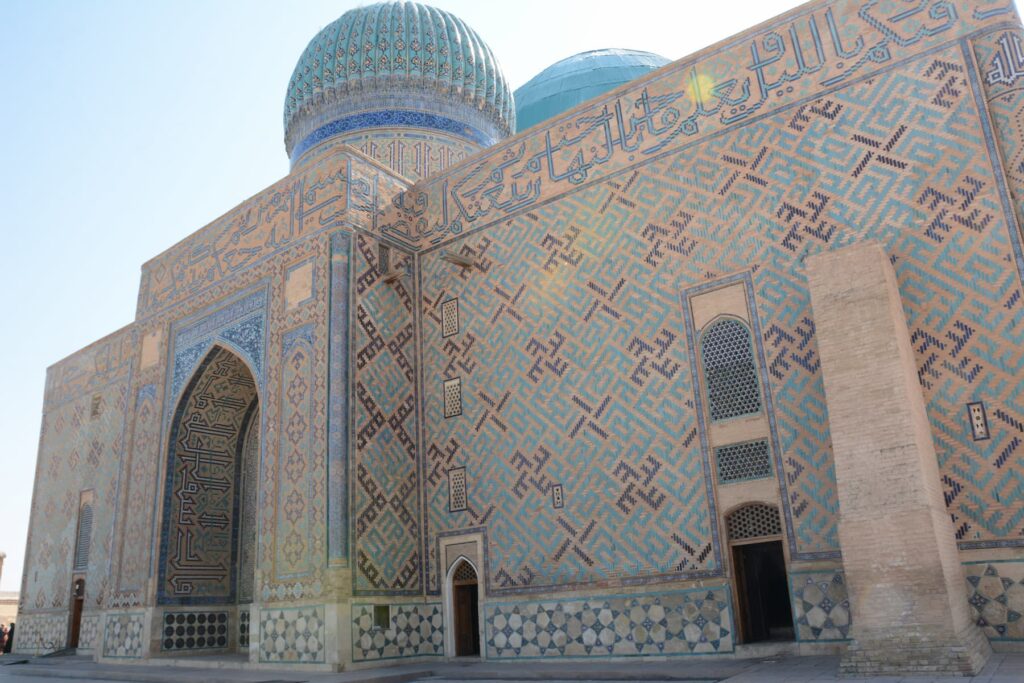
The Mausoleum of Khoja Akhmed Yasawi was built at the end of the 14th century. It’s a striking structure both inside and out, with walls 3-5 meters thick, made of clay mixed with horse hair. The domes tower over the faithful participating in prayer, and there’s an audible reading of the Koran ever present.
Located at the center of the main hall is a bronze cauldron containing 3000 litres of holy water drawn from a deep well. Following Friday prayers, the water is blessed and distributed to pilgrims, who believe it possesses spiritual and healing powers. The Mausoleum became a UNESCO site in 1993.
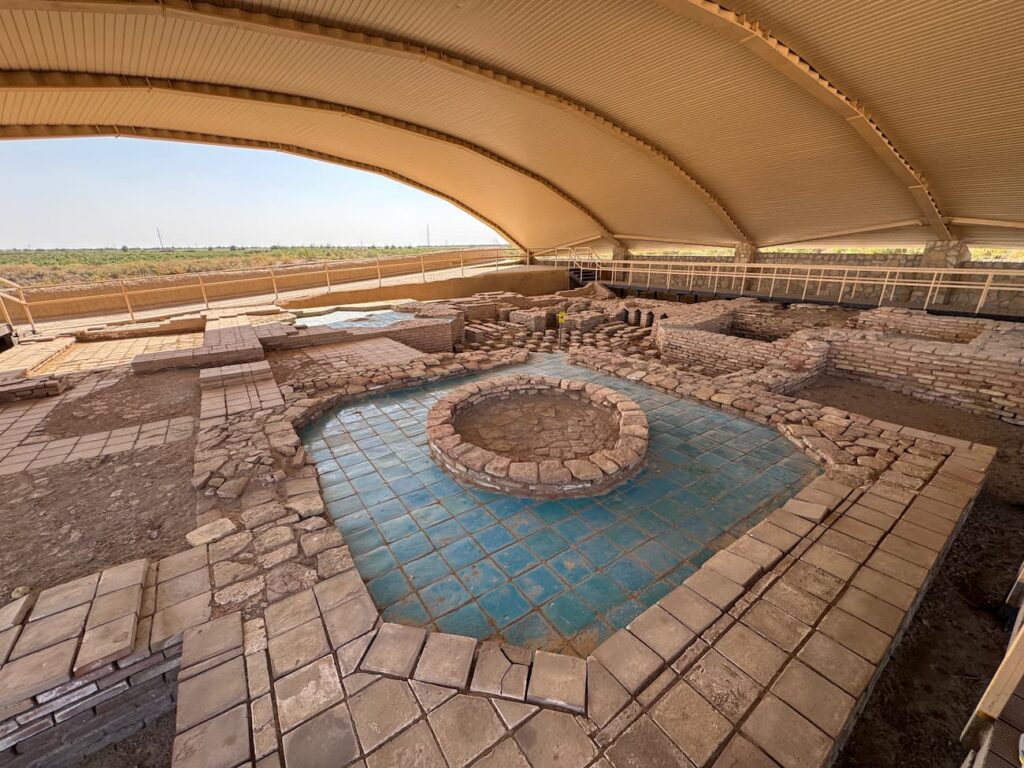
We also toured the underground mosque, and bathhouses from ancient civilizations. During Soviet times, practicing the Islamic faith was prohibited, but it continued underground – literally, in this sacred location. (photos)
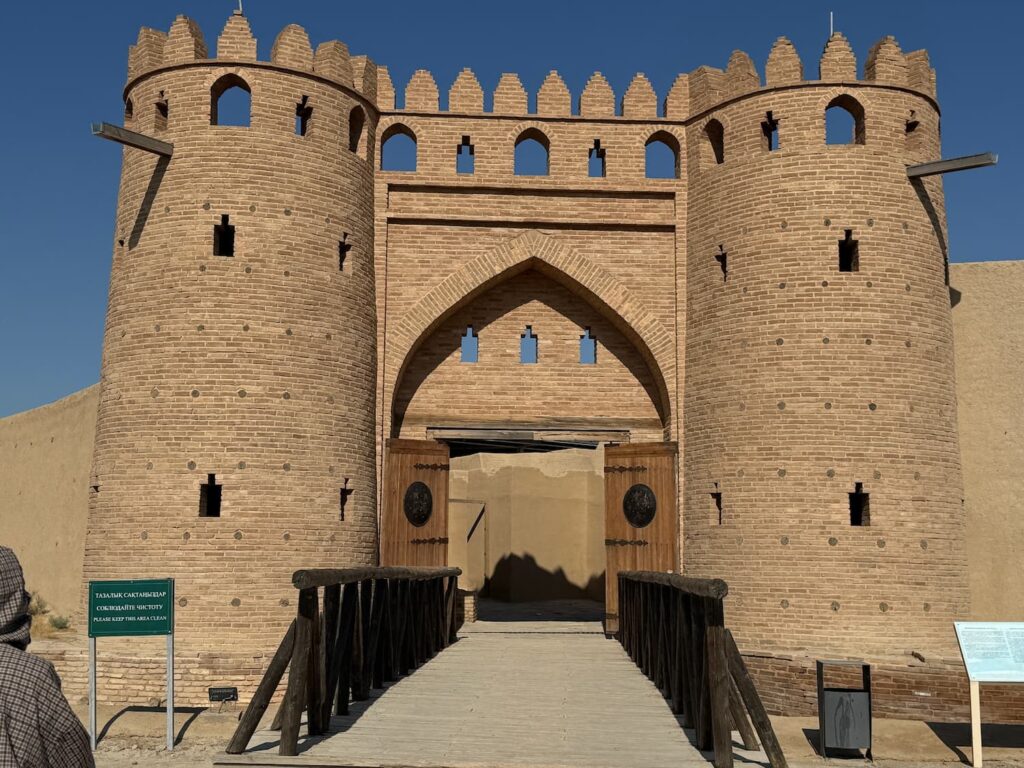
We also ventured to Shymkent, stopping at the ancient settlement of Otar along the way. First excavated in 1969, its history dates back to the first century AD, with remnants of palaces, mosques and bathhouses that can still be seen today.
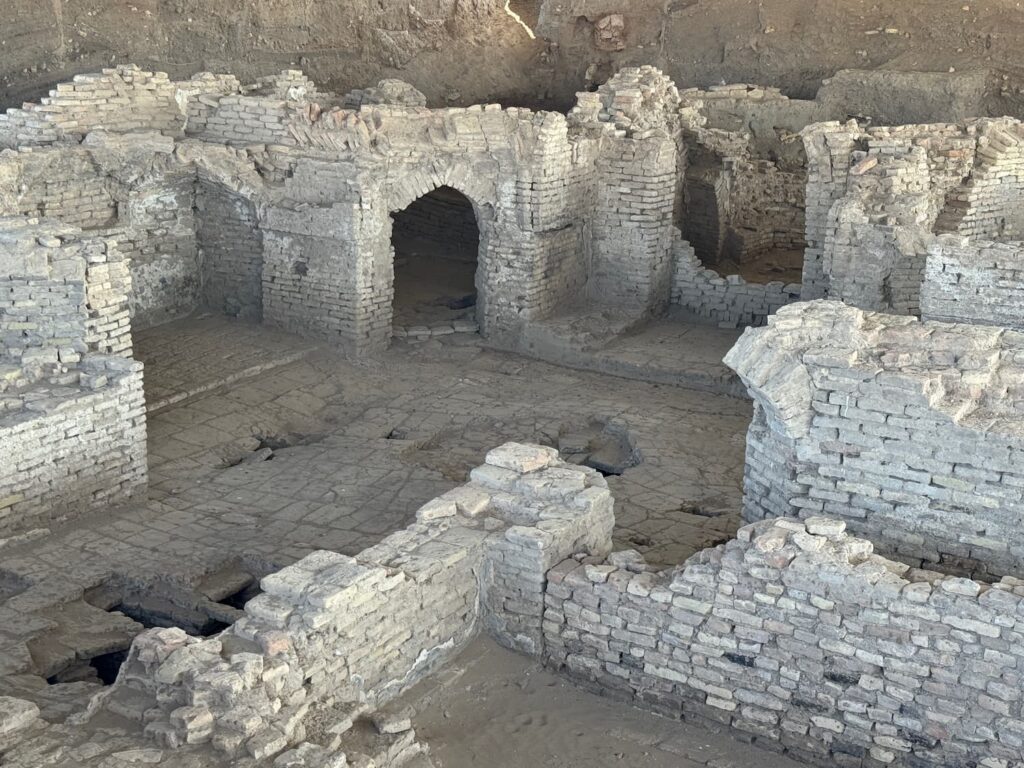
This is also where Genghis Khan’s army is said to have fought when the Mongols first invaded Central Asia. It was incredible to walk the paths and see the remnants of communities placed along the Silk Road.
Our Kazakhstan and Kyrgyzstan adventure continues on a night train
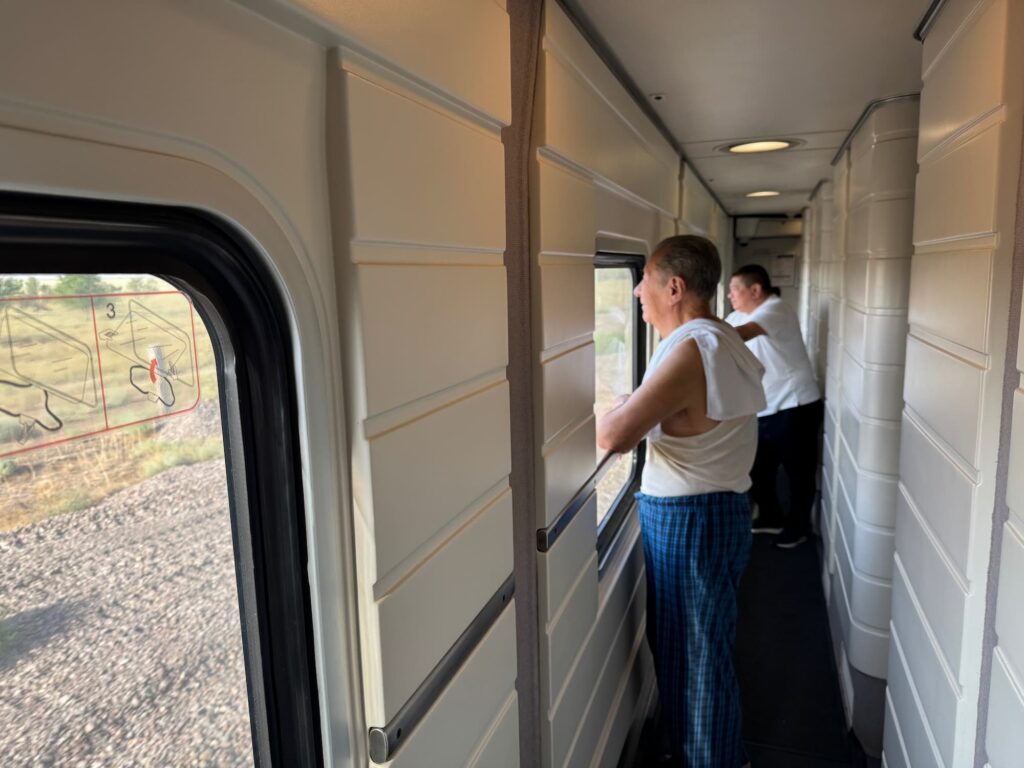
On the evening of the 4th day of our tour, we boarded an overnight train from Turkistan to Almaty. Our group broke into smaller groups of three, each assigned to a four berth compartment. The experience offered even more bonding time with fellow travelers as we descended on the dining car later that night.
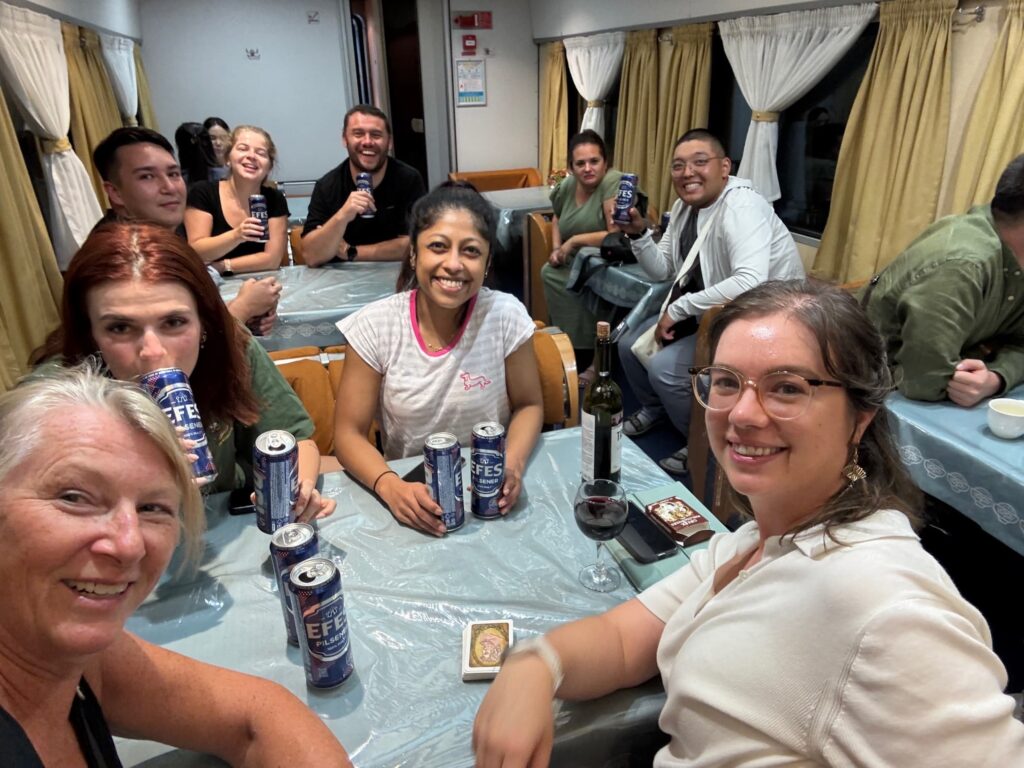
We rode the train mostly with locals. It was relaxing to watch miles and miles of steppe go by, interspersed with the odd settlement, and then the sight of the Tian Shan mountains as we approached Almaty.
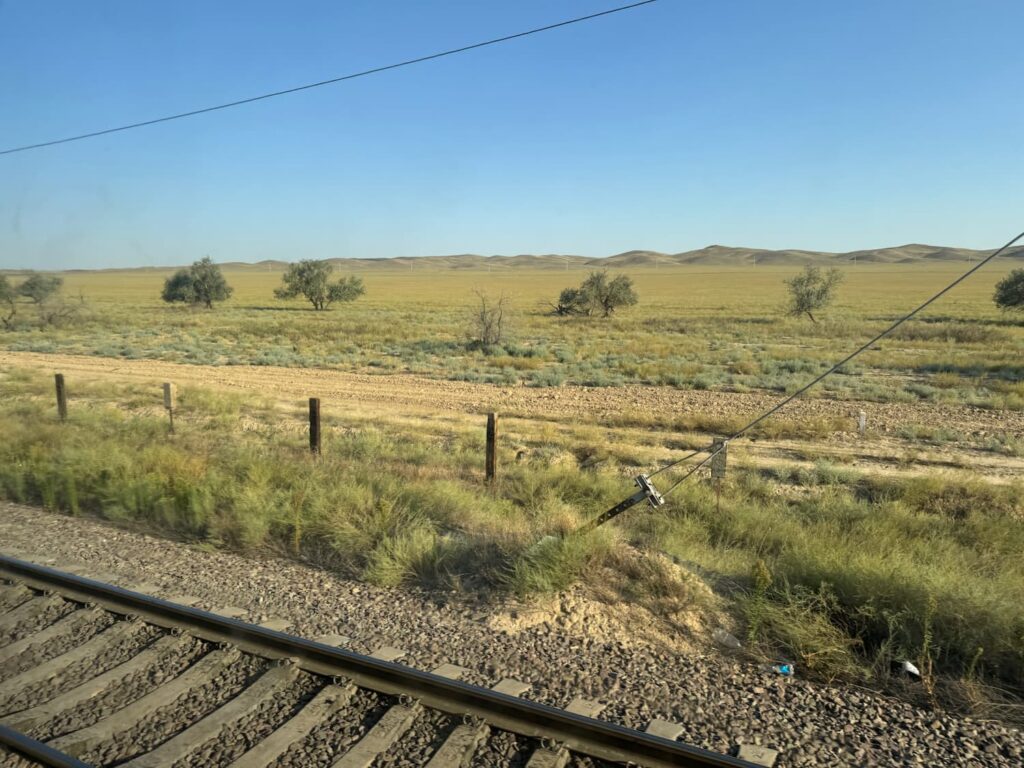
The repetitive “thucka-thucka” sound of the train rails, mixed with the constant feeling of rhythmic movement became pleasantly hypnotic. I had an amazing sleep, and woke to walk through the rail cars in the morning, gesturing and laughing with locals over coffee in the bar car, and then ambling back. It was slow travel at its best, with a window seat to Kazakhstan.
Day 5 & 6: Almaty
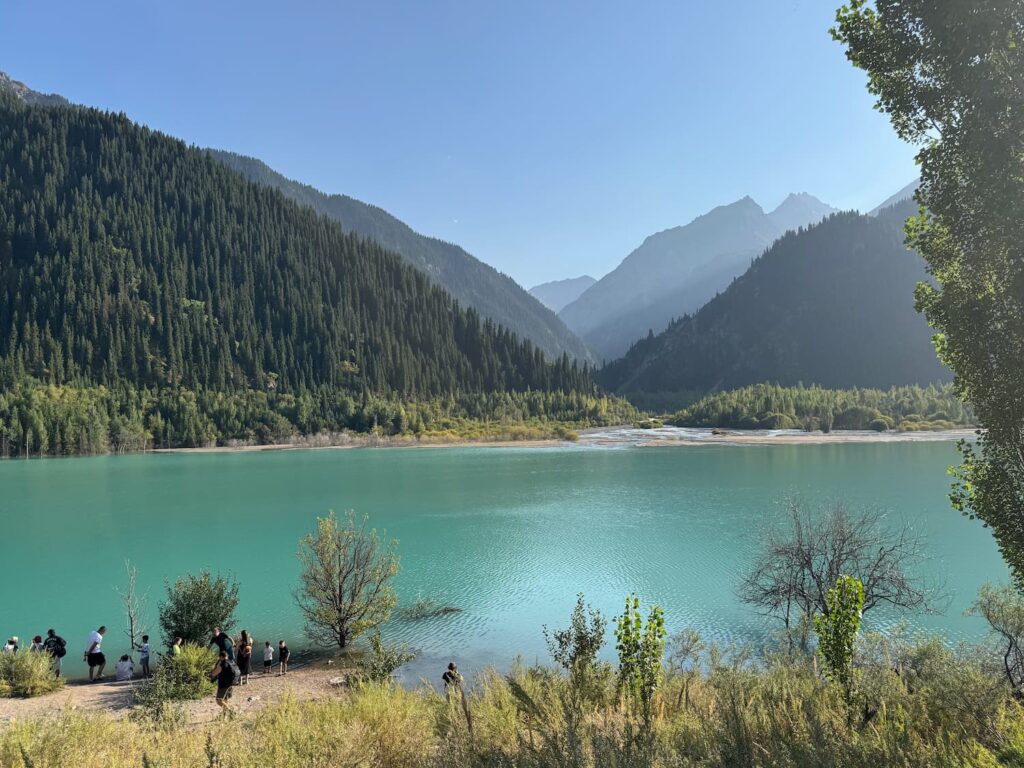
After arriving in Almaty by train in the morning, we grabbed some breakfast, and headed off on a daytrip to Lake Issyk and Turgen Gorge in Ile-Alatau National Park. This would be the beginning of the hiking and outdoor adventure many of us were anxious to embark on. We made a stop at Issyk Museum, an archaeological reserve dedicated to Kazakh history and Scythian culture along the way.
Peaceful Lake Issyk sits in the foothills of the surrounding Trans-Ili Alatau mountains, at an elevation of 1900 meters. The water colour shifts between turquoise, green and deep blue depending on the sunlight and the weather. We were lucky enough to experience both!
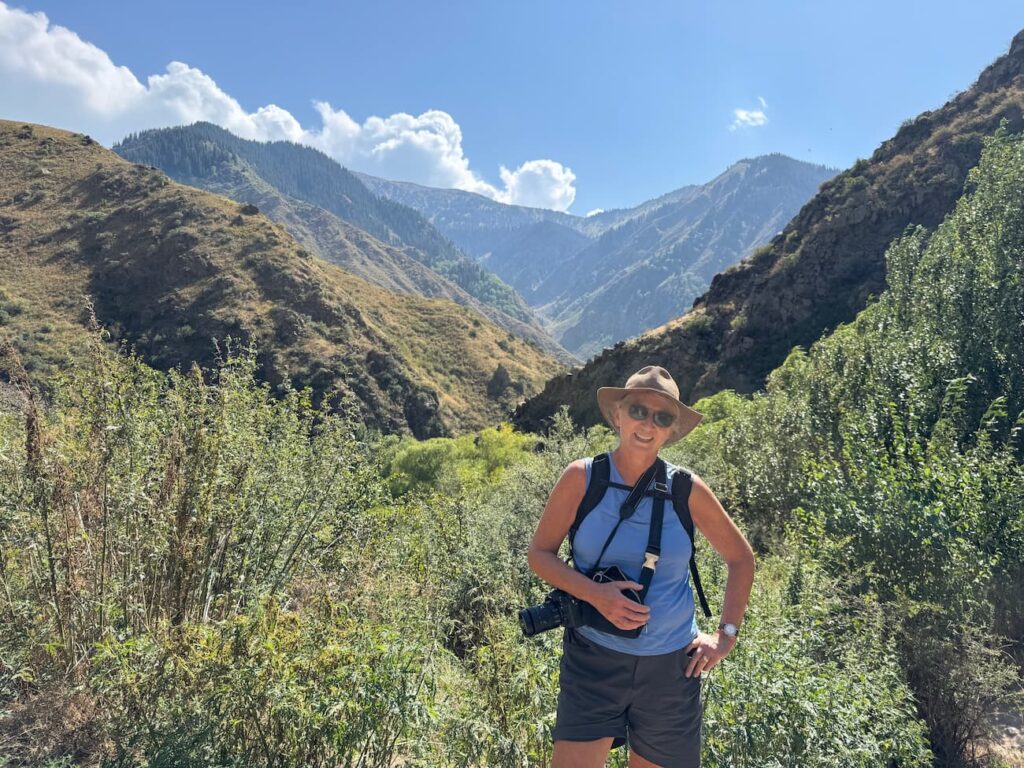
Later in the day we hiked through Turgen Gorge, a scenic alpine valley located in Ile-Alatau National Park. There, we enjoyed an additional short hike to a waterfall, providing a welcome impromptu shower for a few of us, in the summer heat.
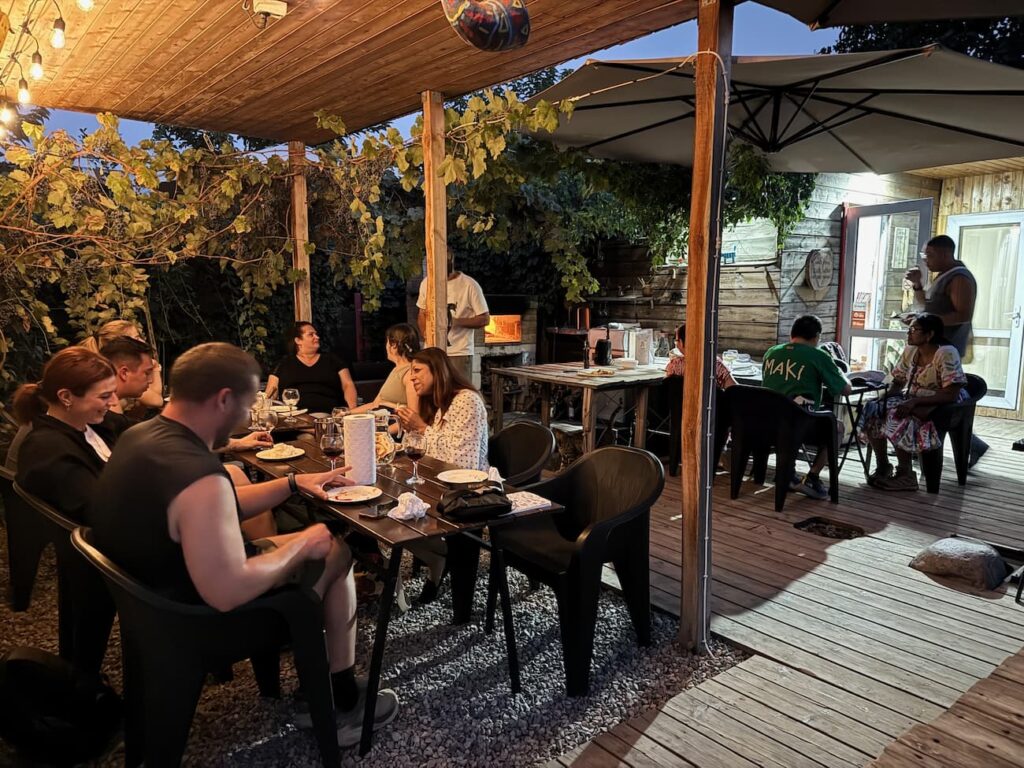
On the way back to Almaty, we stopped by a family vineyard, where we met local craft winemaker Slava, at his https://slavastolyar.com/ winery, to sample wines, and settle in for a chefs dinner, prepared in his outdoor oven. It’s this type of experience, curated by Intrepid to support local tourism, which would be hard to discover independently.
On day 6, our second day based in Almaty, we took a city tour with a local guide.
Almaty
Almaty was the former capital of Kazakhstan until 1997. The city has a completely different feel compared to Astana, with its wide tree-lined streets, numerous parks and views of the snow-capped Tian Shan mountains as a backdrop.
PanFILov Park & Zenkov Cathedral
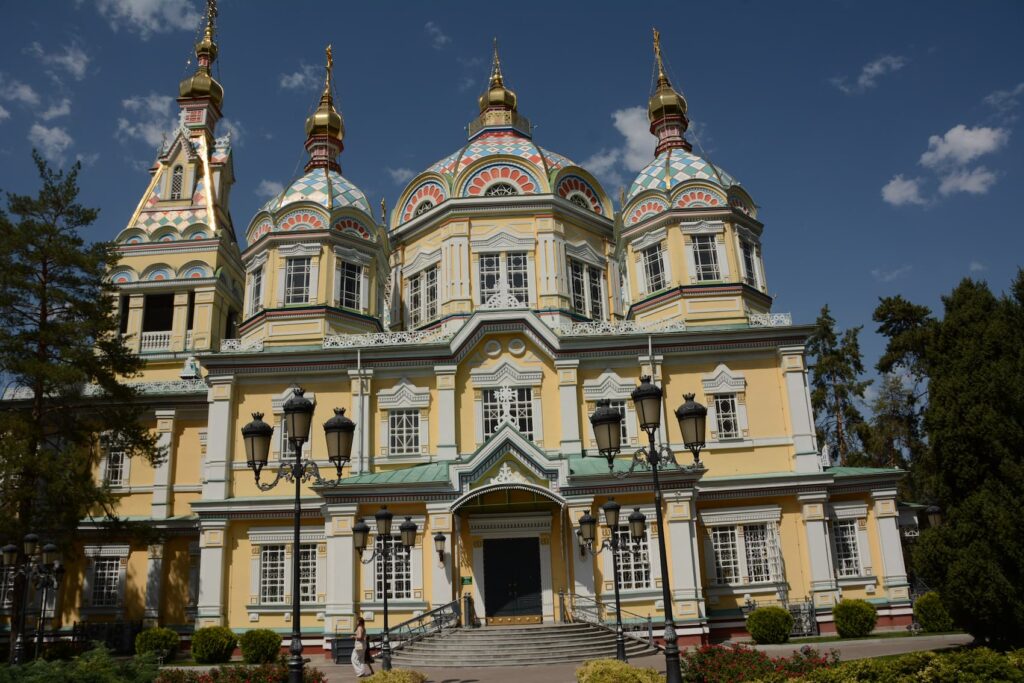
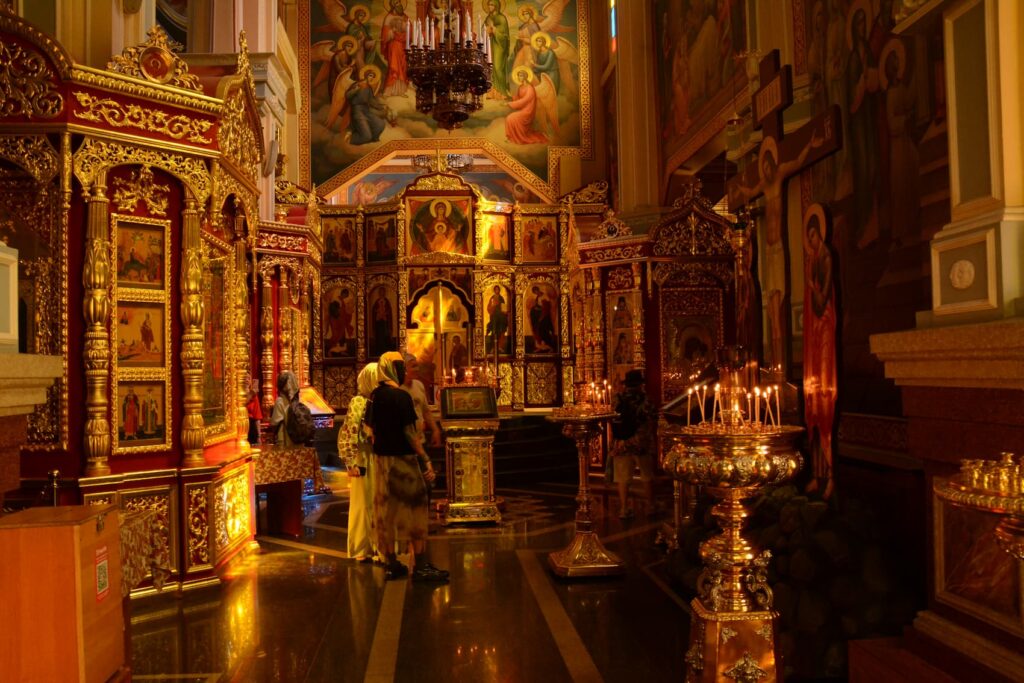
Panfilov Park, created in 1854, is likely the city’s most famous park. Within the park is Zenkov Cathedral, a Russian Orthodox church, built in 1907 entirely without nails. The flexible wooden joints allowed the cathedral to be one of the few structures to survive Almaty’s devastating 1911 earthquake. We were able to visit inside the cathedral, being mindful to observe the custom of covering up.
Memorial of Glory & Eternal Flame
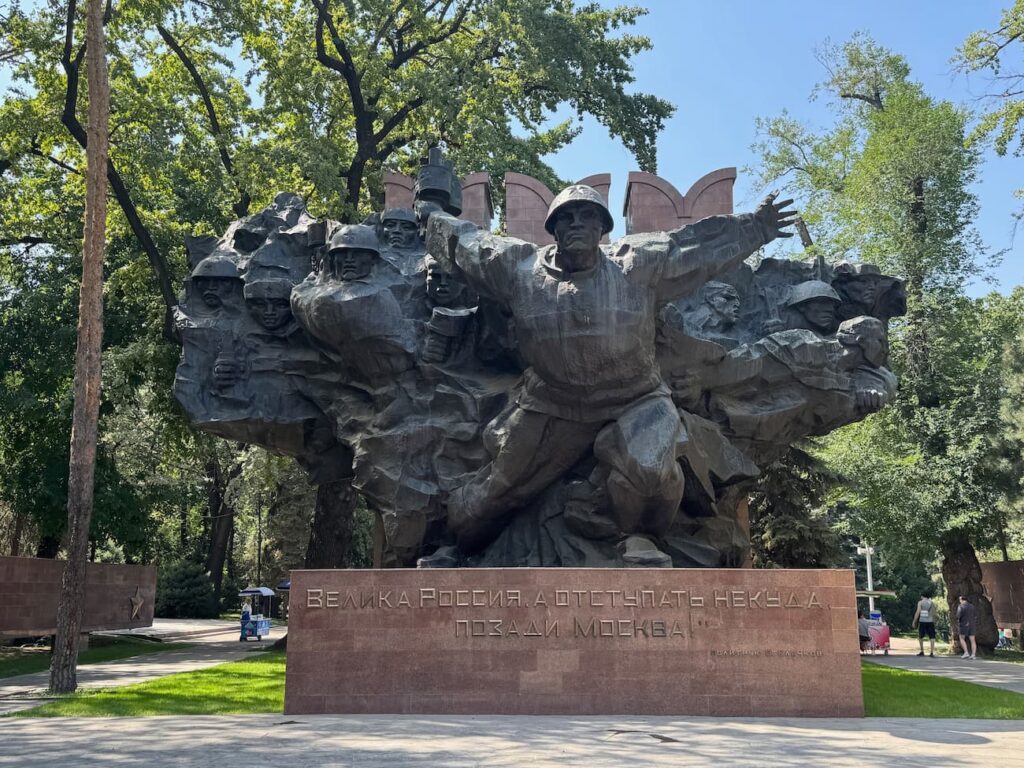
Also within Panfliov Park is the Memorial of Glory, commemorating the division from Central Asia who stopped the attack of Nazis on Moscow in November 1941. Across from the memorial is the Eternal Flame, commemorating the end of the Civil War 1917-1920, and WWII 1941-1945.
Museum of Kazakh Music Instruments
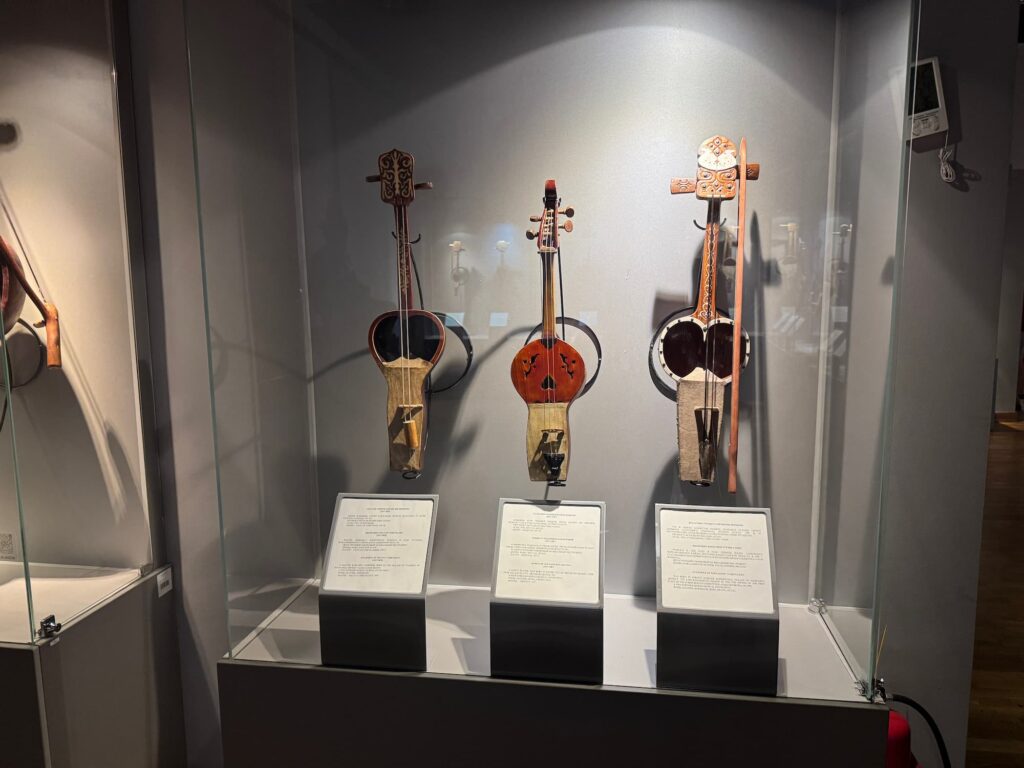
The Museum of Kazakh Music Instruments is a must for historians and music enthusiasts, to gain a greater understanding of the Dombra, a long-necked, 2-string instrument from Kazakhstan, and numerous other instruments used in the culture. Shankobyz – metal jaw harp, and Uzbek Doyra – a Central Asian frame drum with metal rings inside, creating a tambourine-like sound, were also on display.
Green Bazaar
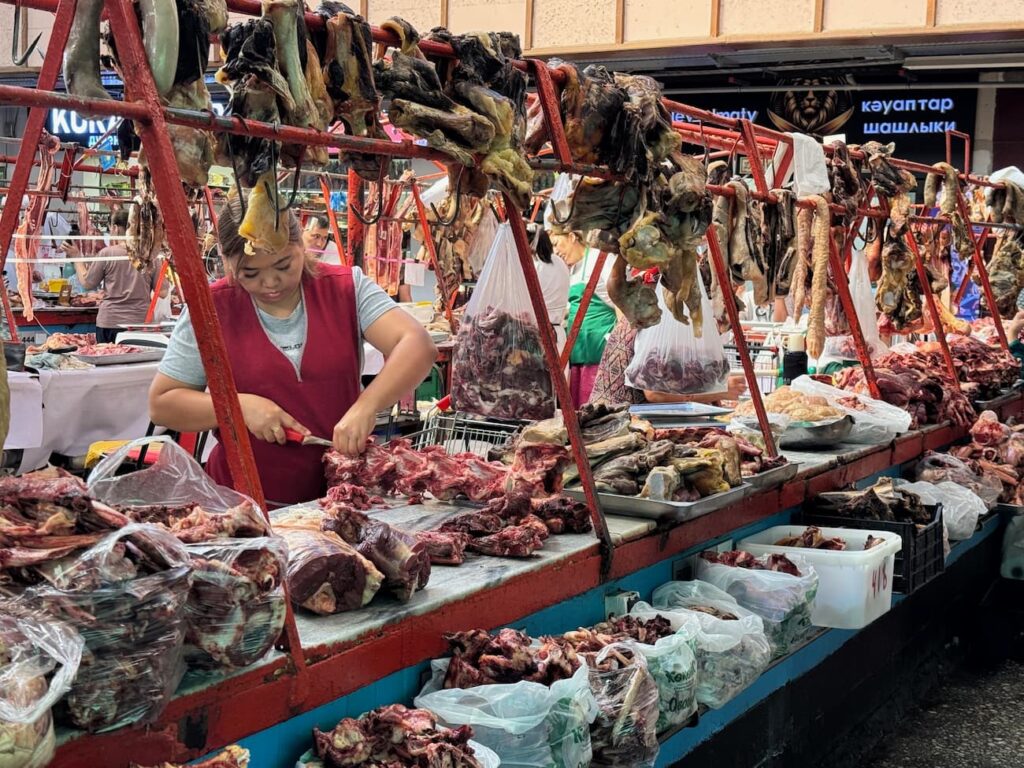
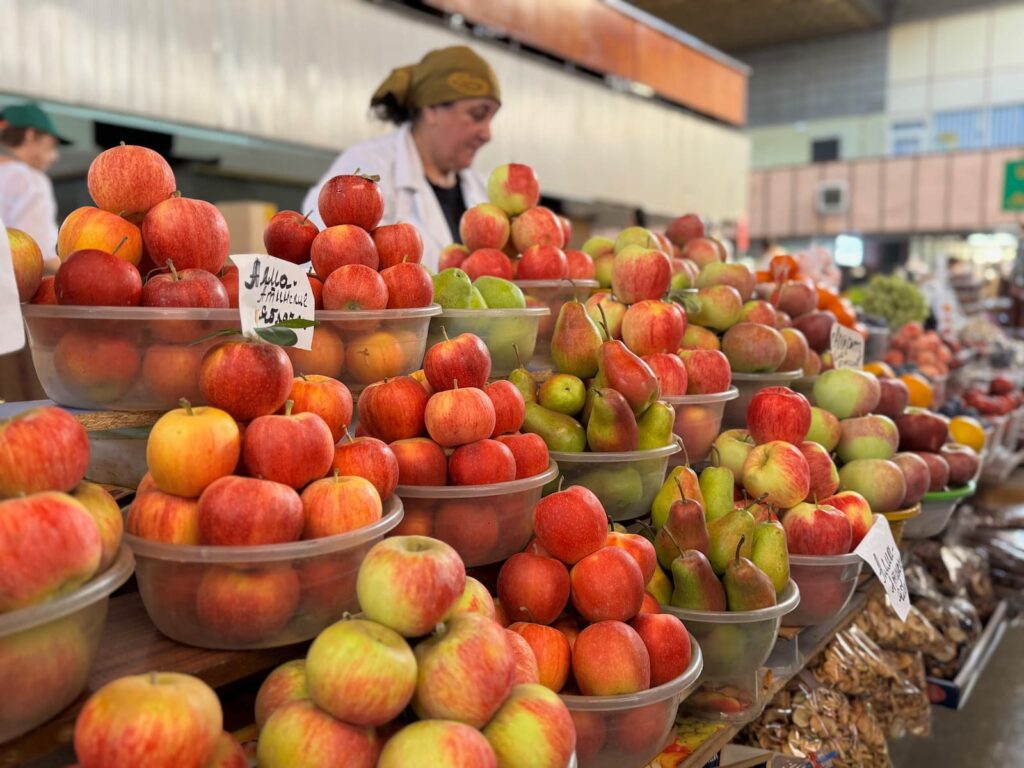
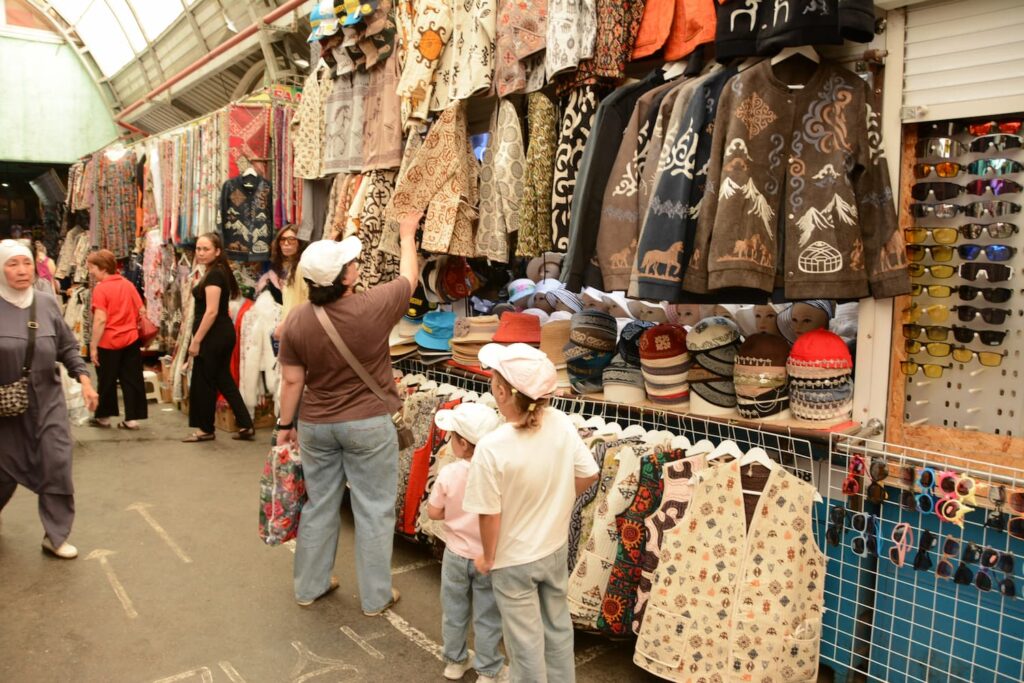
The Green Bazaar, known locally as the Zeleny Bazar, is the oldest and most famous public bazaar in Almaty. The historic hub dates back to 1875, and houses a large food market and clothing market. The bazaar is frequented by locals for retail goods and to provision for the week. Since the diet of Kazakhstan is heavily meat focused, be prepared to see a glorious display of products for carnivores in addition to vegetables, fruit and teas. Plus there’s an additional market area devoted entirely to clothing and housewares, a modern day Silk Road in a maze of stalls.
Almaty Metro
Our tour took us to Abai Station on Almaty’s Metro, where we then walked back through the city. But it’s worth noting that the Almaty Metro is a tour destination in its own right. It’s very modern, efficient and has stunningly beautiful underground transit stations.
Kok Tobe
Kok Tobe Hill in Almaty, is a 1100 meter peak that offers panoramic views of the city and the Tian Shan mountains. It’s popular at sunset, and several of our group ventured up the cable car one evening. I had visited the attraction when based in Almaty for the conference prior to the tour, so these photos are from when I joined locals to walk up the hill on the “Health Walk” from a different entrance.
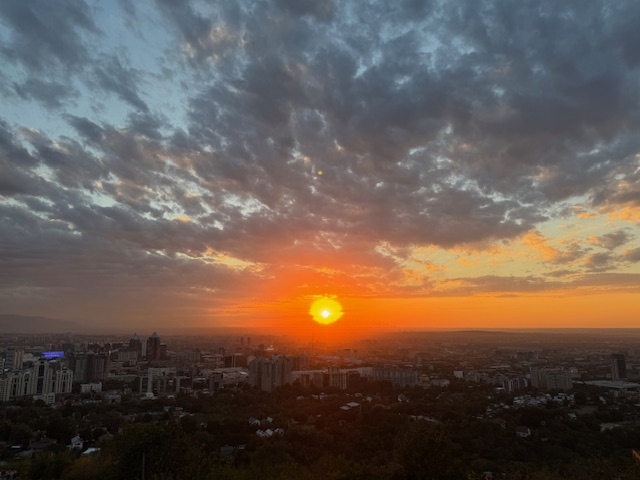
The cable car entrance was located close to our accommodation, but I would recommend the walk up if you have the time and fitness. It took about 30-45minutes one way along a paved walkway and offered free access, both up and down. Alternatively, return cable car tickets are available at the top, but be mindful that the base of the cable car and where you walk up are completely different locations.
The Kazakhstan and Kyrgyzstan adventure gets physical!
We had done lots of walking, touring and some day hikes to this point, but our group was happy to experience some of the great outdoors Kazakhstan and Kyrgyzstan will become known for.
Day 7: Charyn Canyon and SatY Village
In the morning we drove from Almaty to Saty Village, with our driver and van for the next several days, stopping at the spectacular Charyn Canyon along the way.
Charyn Canyon
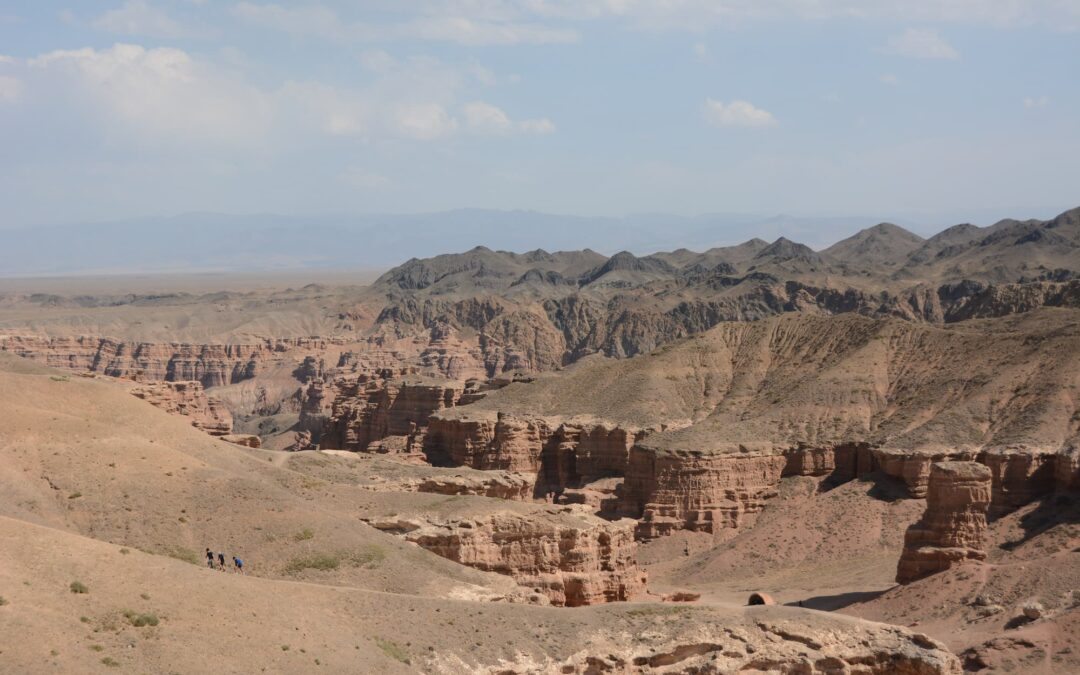
This richly coloured canyon carves a path through the surrounding landscape. Sculpted out of red sandstone by the wind, water and sun over 12 million years, it’s 300 meters deep in some places. The canyon is genuinely jaw dropping juxtaposed against the endless steppe, with vivid tones of oranges and browns shifting and changing as the sun travels across the sky.
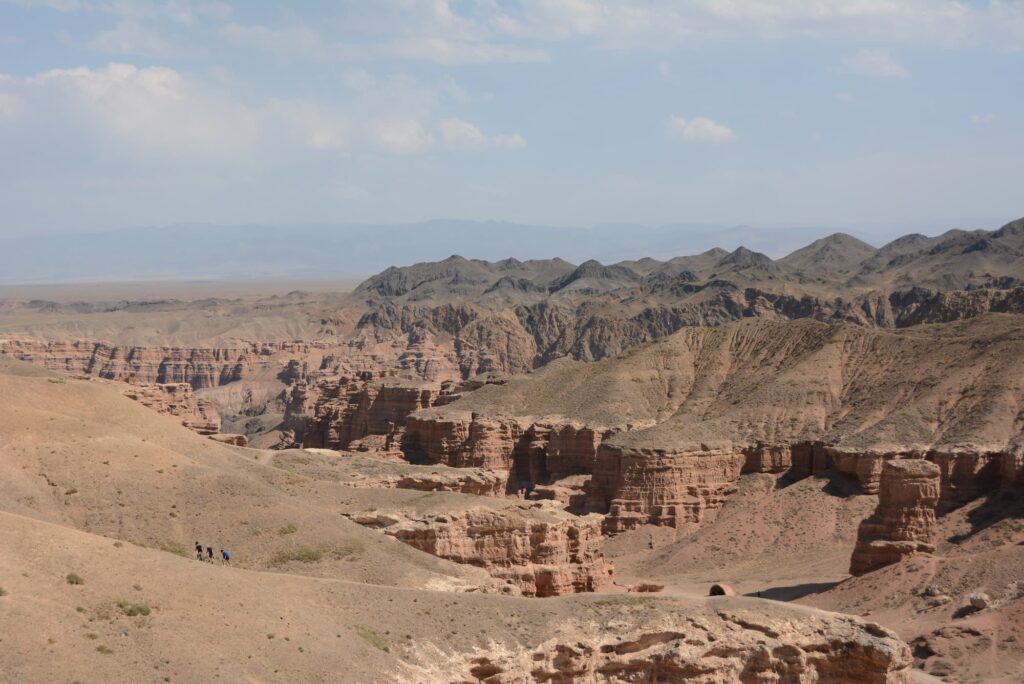
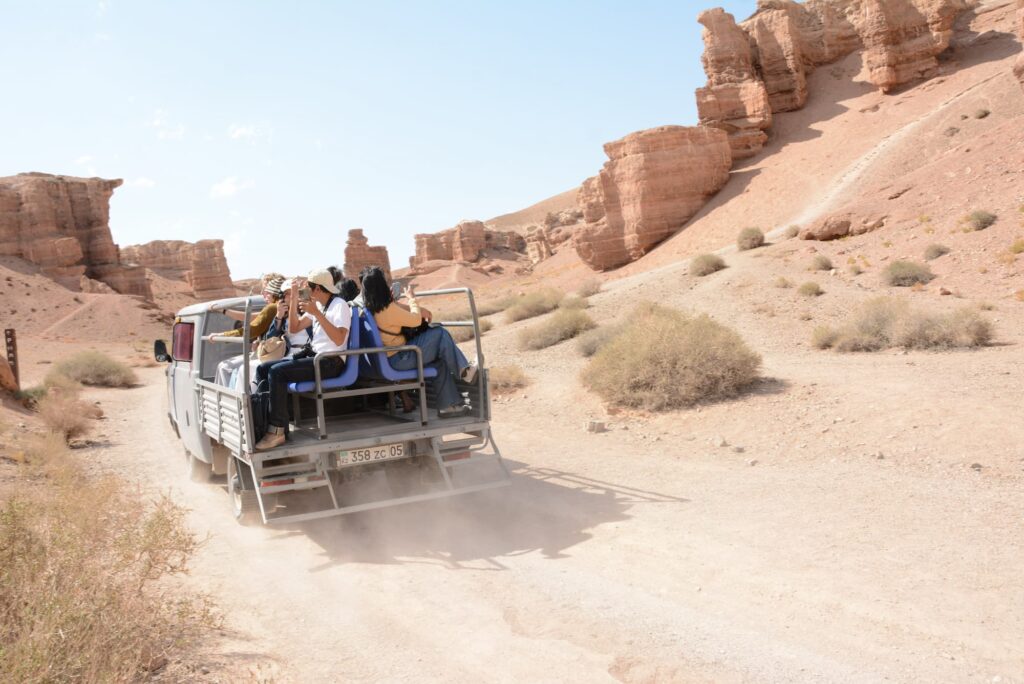
It was a hot day, but most of our group elected to hike both up and down into the canyon to the river below. Shuttle vans were available for hire for those who wanted a lift in either direction.
After a full day hiking we returned to Saty Village and checked into our homestay, experiencing a taste of local life and a home cooked meal. And there may have been dancing on the porch later! Seems our guide Nursultan was an aspiring DJ, and with a boom box hooked up to his local music playlist, and a ready group of participants, we dance to the music under a full moon. It was truly one of the unexpected fun highlights of the trip. It’s safe to say, by this time the group had bonded!
Day 8: Kolsay Lakes / Border crossing / Karakol
Kolsay Lakes National Park is about 12km from Saty, so we visited both Kolsay Lakes and the lesser known Kaindy Lake this day.
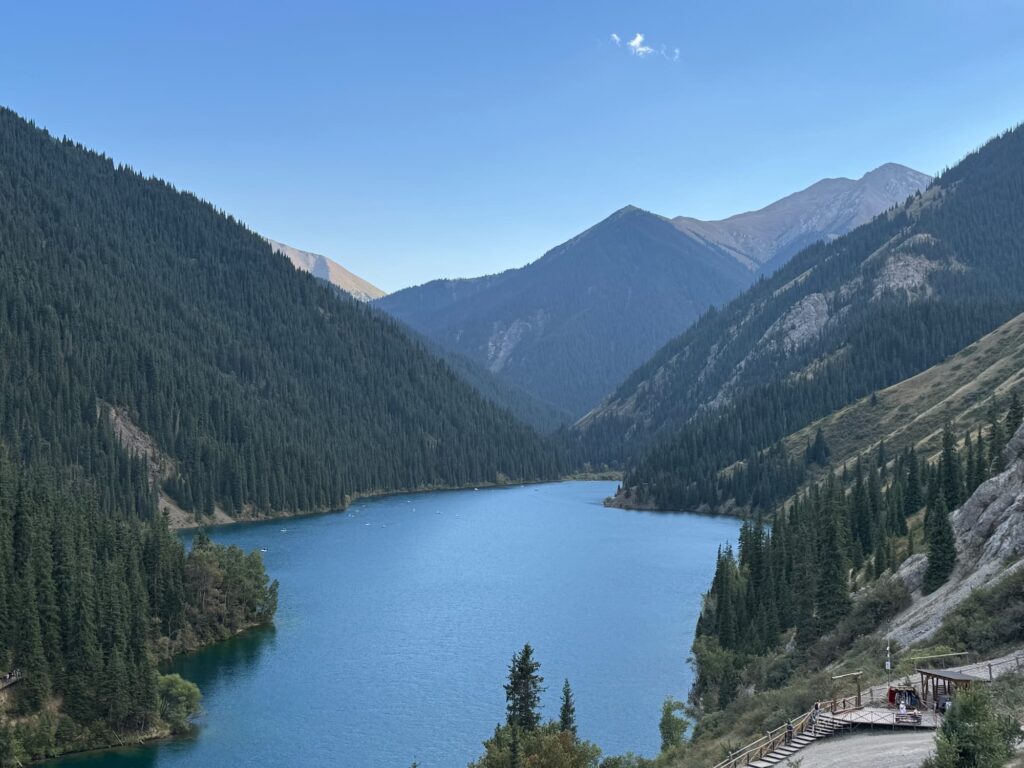
Kolsay Lakes, is known as “the blue necklace” for its clear blue waters framed by the mountains. It sits between the steep spruce covered foothills of the Kungey Alatau. It appears lush and serene, and quite the contrast to the endless steppe and Charyn Canyon we had experienced the previous day.
Some of the group chose to walk the areas boardwalk surrounding the end of the lake, while others got out on the water for some paddle boat fun.
Kaindy Lake submerged forest
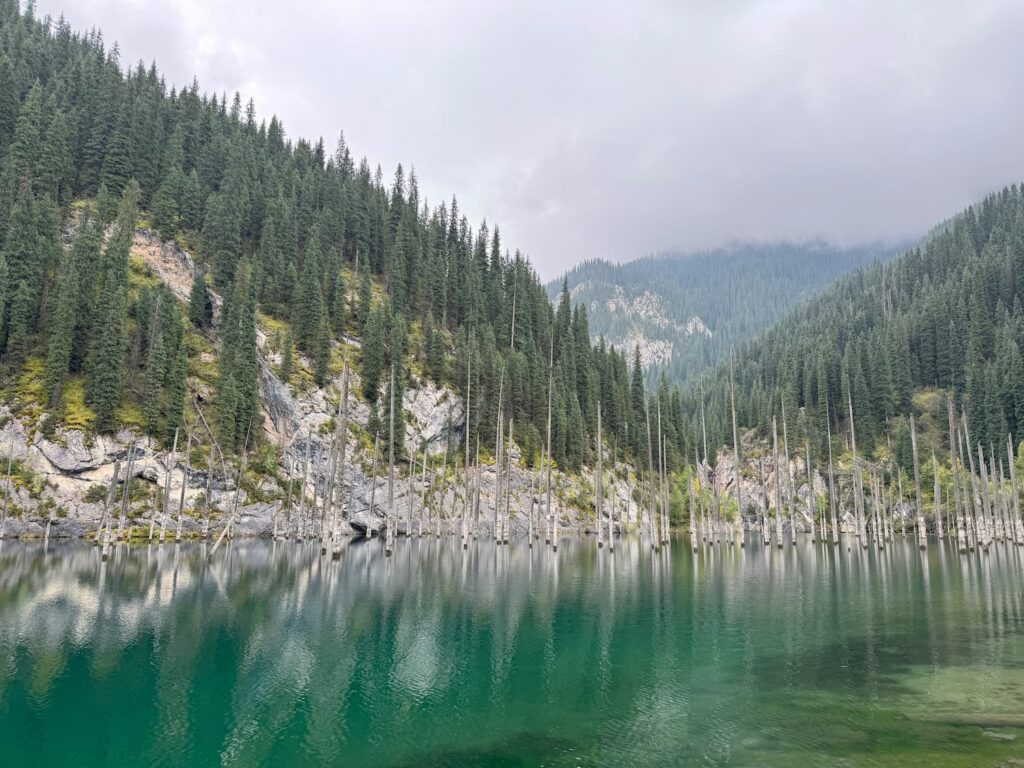
Later we ventured to Kaindy Lake, a turquoise lake with a “submerged forest” protruding from the water. The trees are actually dead spruce, submerged when the lake was created by an earthquake in 1911, when a limestone landslide created a natural dam in the forest. As time went on, the dam filled with water and the trees became covered, leaving just their trunks standing in the centre.
Getting up to the lake in an old Soviet van proved half the fun, and the time saved walking allowed us more time to hike around the park area, along the trail system and metal walkways traversing creeks through the valley. (photos)
We then headed off for the Kegen border crossing, a scenic, remote land route connecting southeastern Kazakhstan to Karakol in Kyrgyzstan. Intrepid had seamlessly organized a different van and driver to meet us on the other side, making our crossing quick and efficient, once we had cleared border patrol. Although locals do pass through the border in their own vehicles, its best for foreigners and those in groups to walk through security and then arrange transport on the other side. The whole process is very official with military guarded personnel from each country stamping passports departing and entering, as well as scanning luggage.
Our destination for the night was Karakol, in Kyrgyzstan.
Day 9: Karakol
In the morning we headed out on a city tour of Karakol. Once a small Russian military post, then a bustling soviet state, this town was bursting with history, and a true local vibe.
We visited the Dungan Mosque, built in 1910. This colourful mosque was created without the use of a single nail, instead utilizing special cutting and groove techniques. We also explored the Holy Trinity Orthodox Cathedral, and a local market.
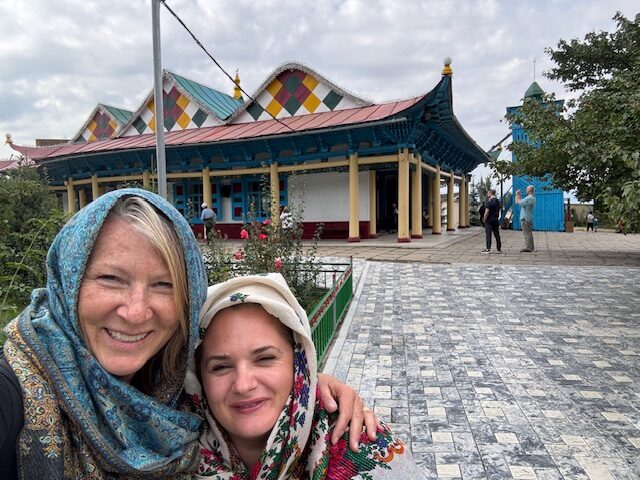
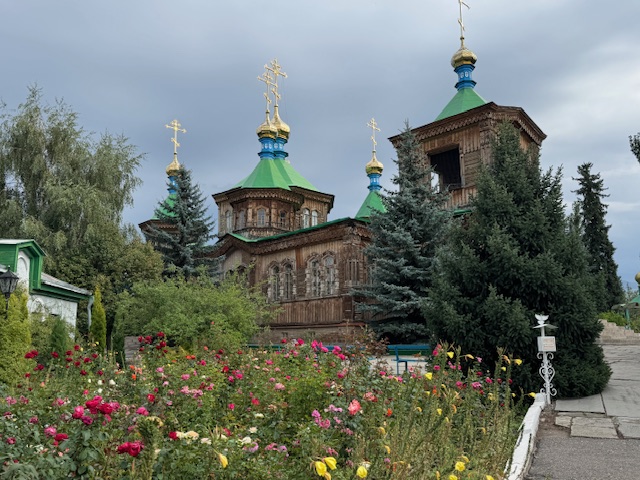
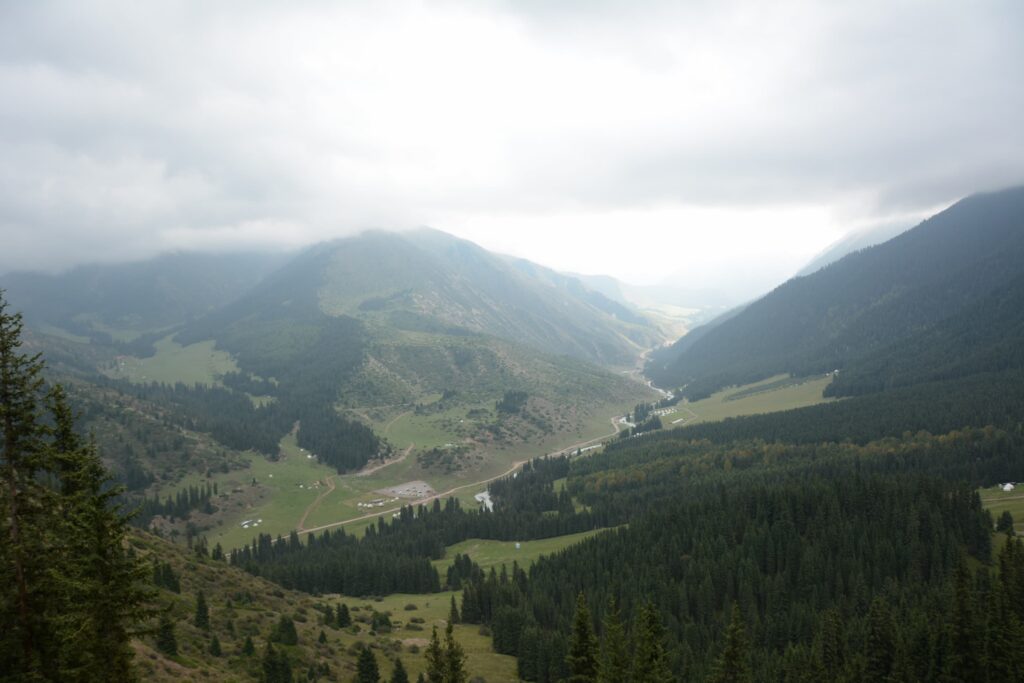
In the afternoon we drove to the Jeti Oguz area, and Seven Bull Valley, where Nursultan lead us on a forest hike to a waterfall. This was honestly one of the most memorable days for me, immersed in the Kyrgyzstan landscape of mountainous hills, yurt camps, hiking, waterfalls and rivers, and horses. The Seven Bulls red rock mountain formation, framed by dense pine forests was also pretty spectacular.
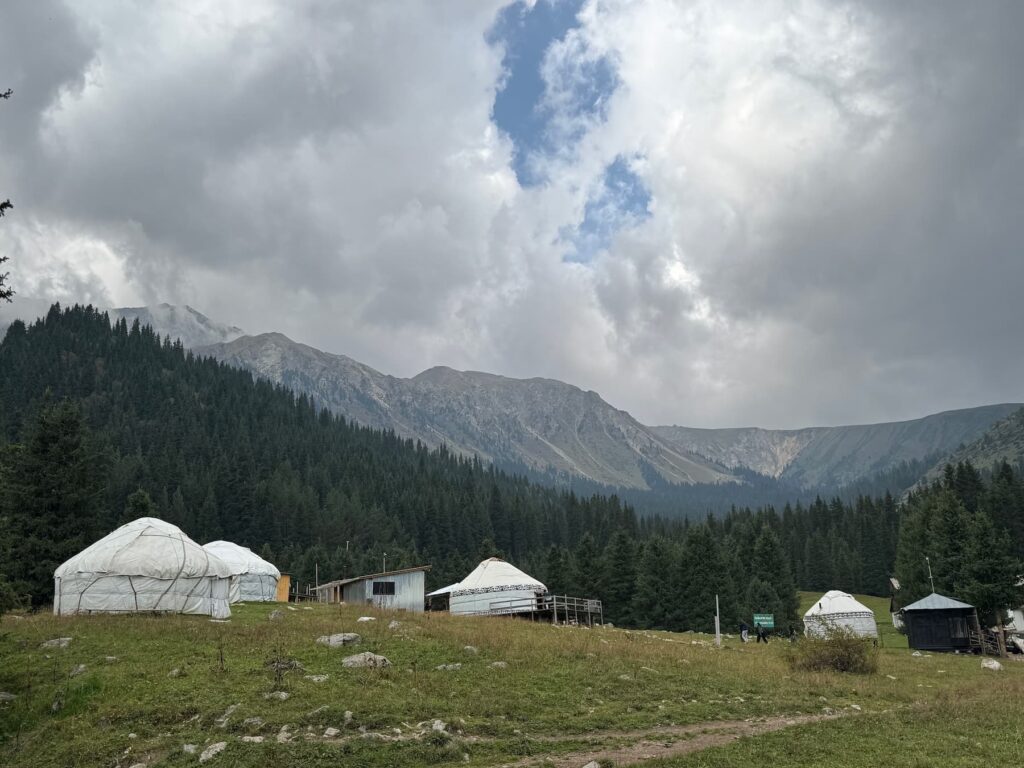
Along the way we viewed the house where Yuri Gagarin, the first Russian Cosmonaut to go into space, stayed. Yuri reportedly visited the local thermal hot springs after his space launch, as part of his recovery. Those hot springs remain very popular with locals in the area.
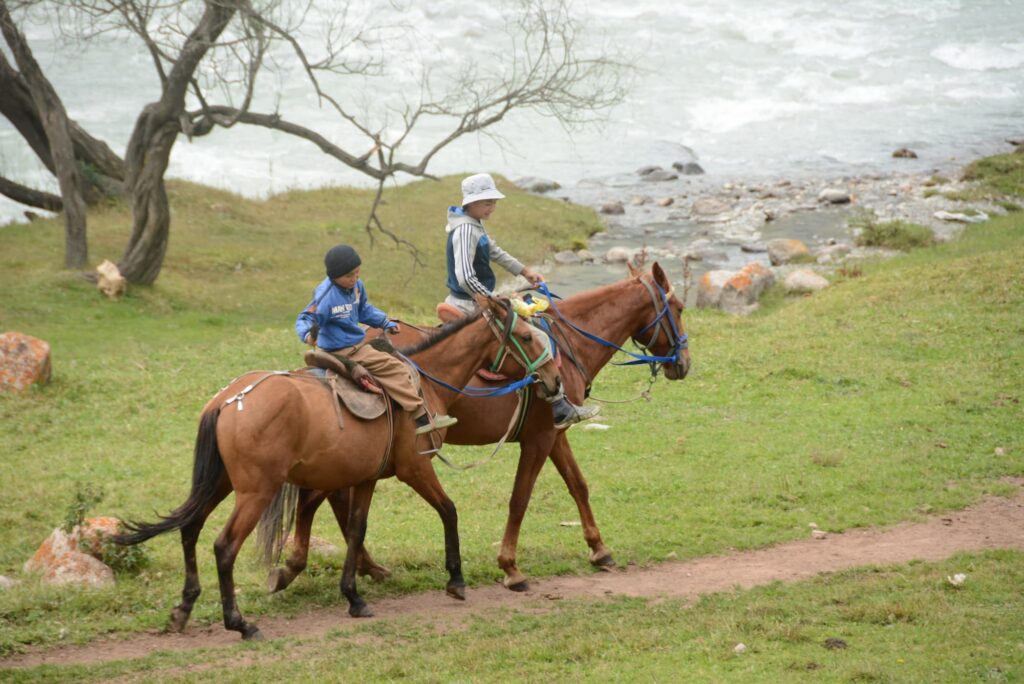
Later we returned to Karakol, and participated in a traditional Dungan dinner, a private affair, with a local family arranged by our guide. It was a wonderful evening of history and education through traditional Dungen food, a delicious blend of traditional Chinese-Hui Muslim heritage with Central Asian flavours. Our host invited a few group members to help make noodles for our meal. Let’s just say Franny rocked it!
Day 10: Bishkek
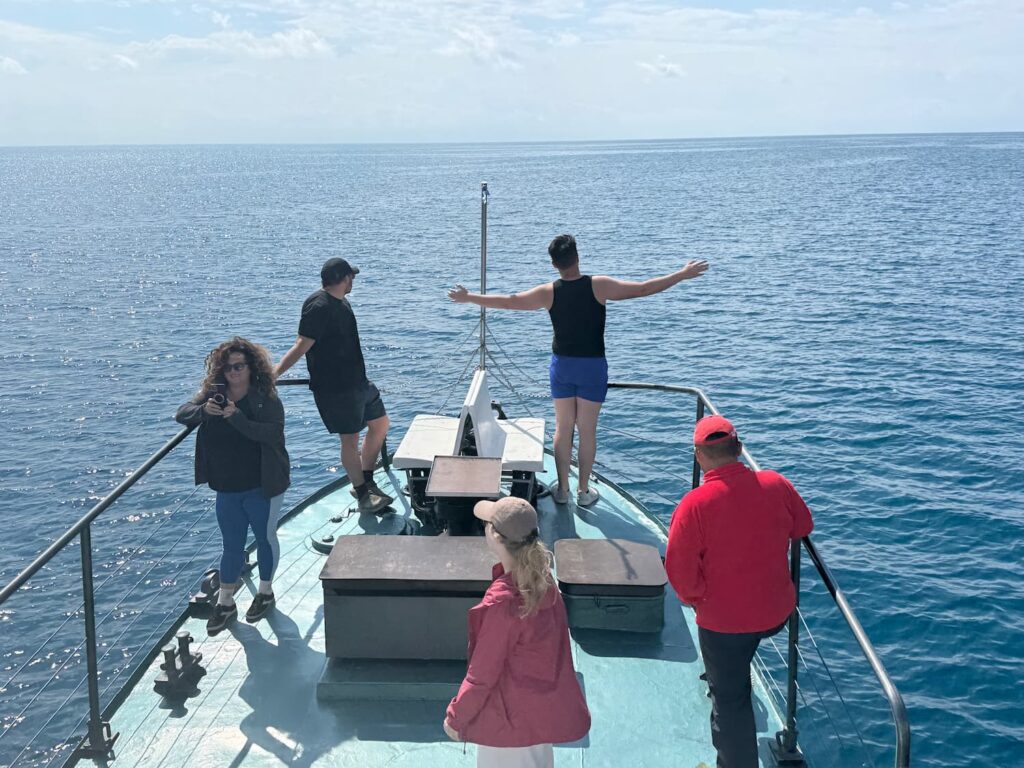
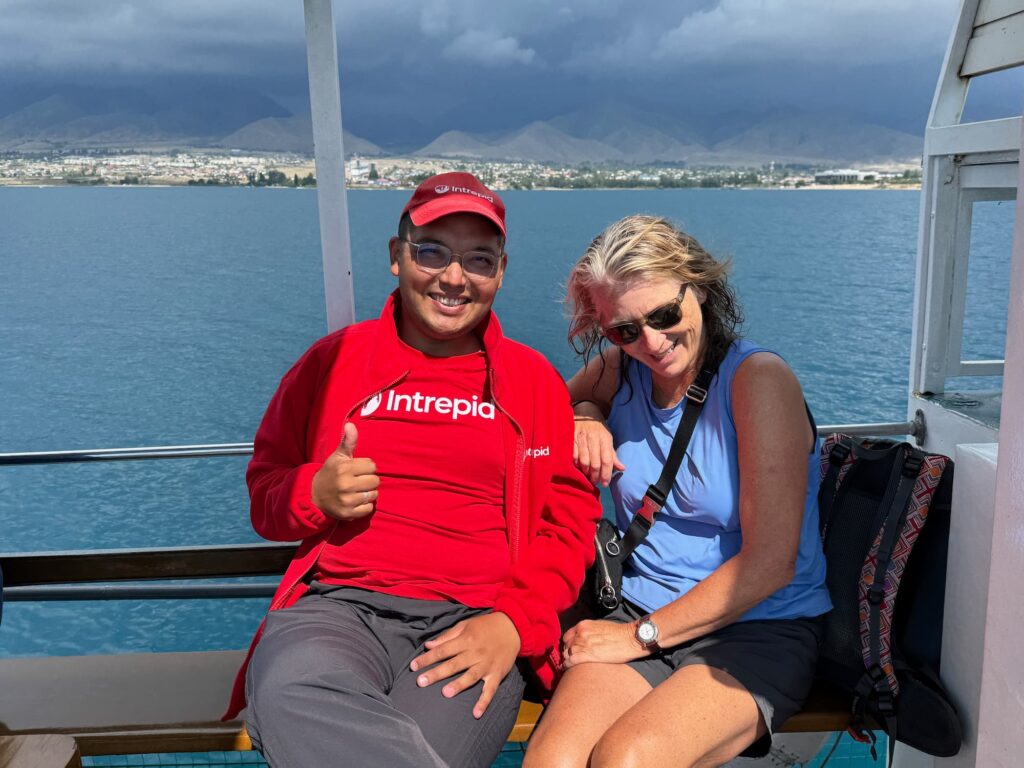
On day 10 the plan was for a full day’s drive to Bishkek along the northern shore of Issyk Kul, with stops along the way. Issyk Kul is the second largest alpine lake in the world after Lake Titicaca in South America. The insanely intense light blue colour of Issyk Kul was not only beautiful from a distance, but we were able to experience it up close, on a private charter boat ride, with a swim and lunch.
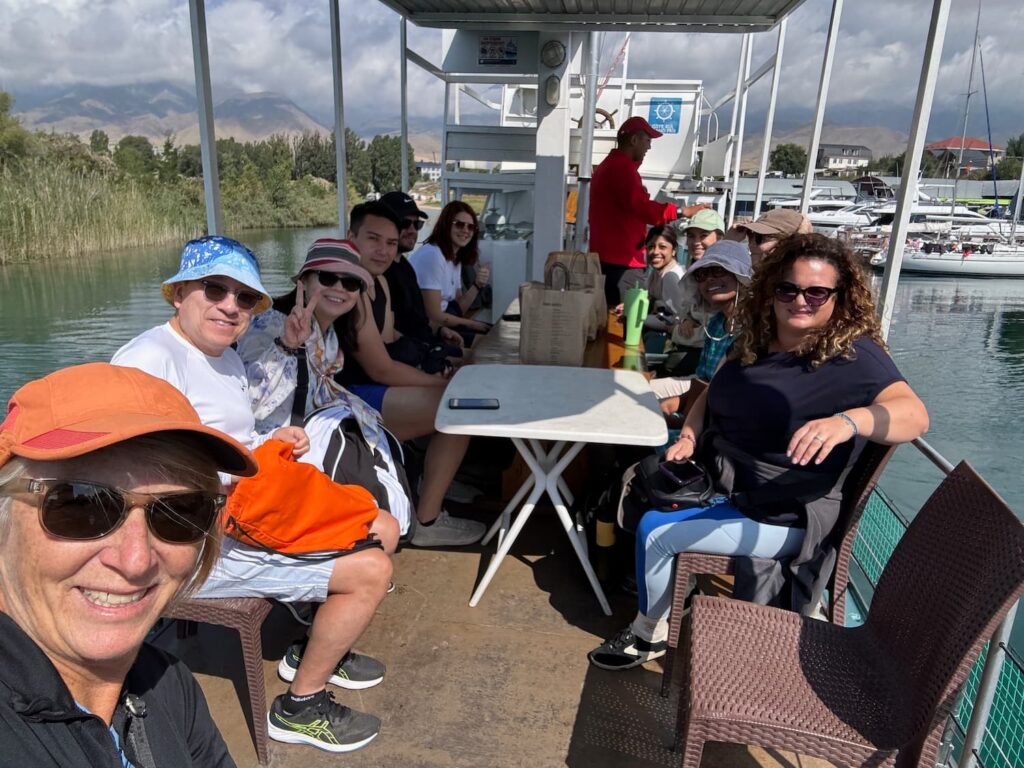
Floating out on the huge alpine lake allowed us to soak up the beauty of the warm summer water. Issyk Kul is a slightly saline lake, due to the geothermal activity beneath. This is also why the lake never freezes over, even in winter, despite being a high-altitude mountain lake, surrounded by snow-capped peaks.
On our way to Bishkek, we stopped at Cholpan Ata, a popular resort town on the northern shore of Lake Issyk Kul to visit a petroglyph site. There we viewed carvings dating from the 2nd millennium BC, through the 3rd century Bronze Age, up to the Turkic era.
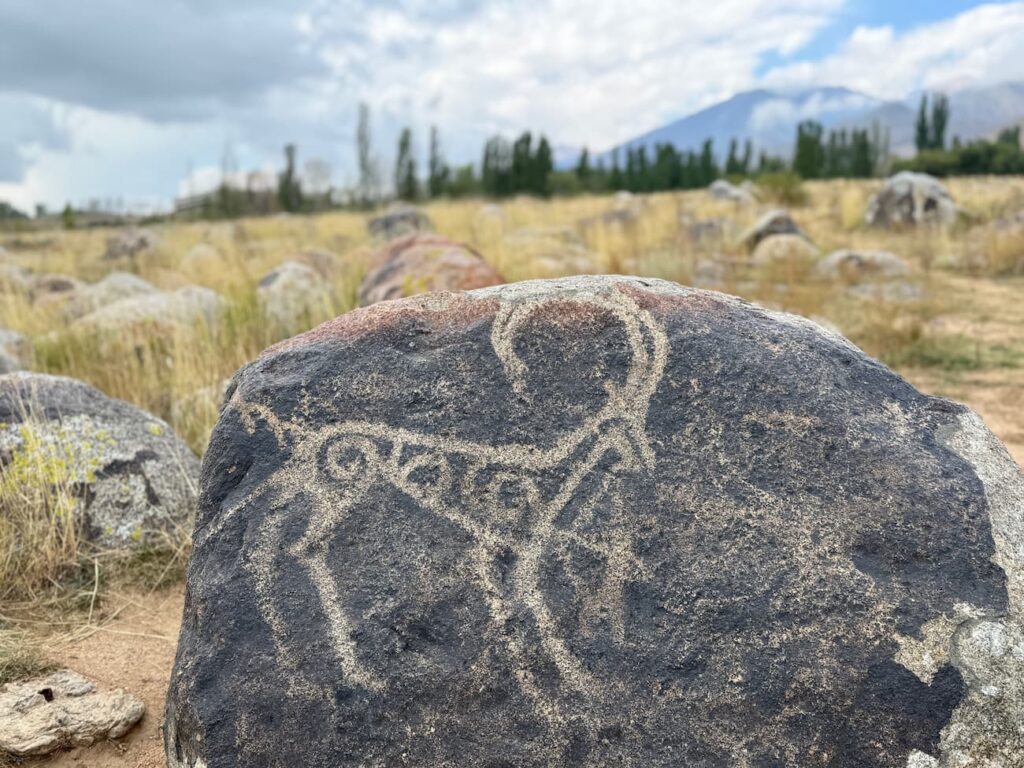
Since we were touring during a time when the 2026 Nomad Games were taking place, based out of Cholpan Ata, we also were able to see some of the exhibits, Nomad Museum, and arena where many of the events were taking place. While this was not part of the official Intrepid itinerary, we appreciated our guides willingness to make some time in our schedule for this international event.
Our Kazakhstan and Kyrgyzstan adventure comes to an end
Our evening in Bishkek was a farewell dinner, and a lovely send off for folks catching early morning flights. We had already said farewell to several who had signed out of the tour in Cholpan Ata, with plans to take in the Nomad Games for several days.
Day 11: Bishkek
The official Intrepid tour concluded after breakfast on day 11. But for those of us leaving later in the day, it was a great time to tour Bishkek on our own. I elected to search out the purchase of a Kyrgyzstan 3-string Komuz at the Osh Bazaar, after being inspired by guest musicians during dinner in Karakol. I had wanted to purchase a 2-string Dombra while in Kazakhstan, but found the Komuz had a livelier sound, and it was more compact to transport at the end of the trip
The Osh Bazaar is a must experience in Bishkek. It is overwhelmingly large, so let’s just say it was a good thing I had several hours to find the Komuz sellers! But it was an amazing experience in itself to visit and shop with locals, getting lost in the maze of retail stalls.
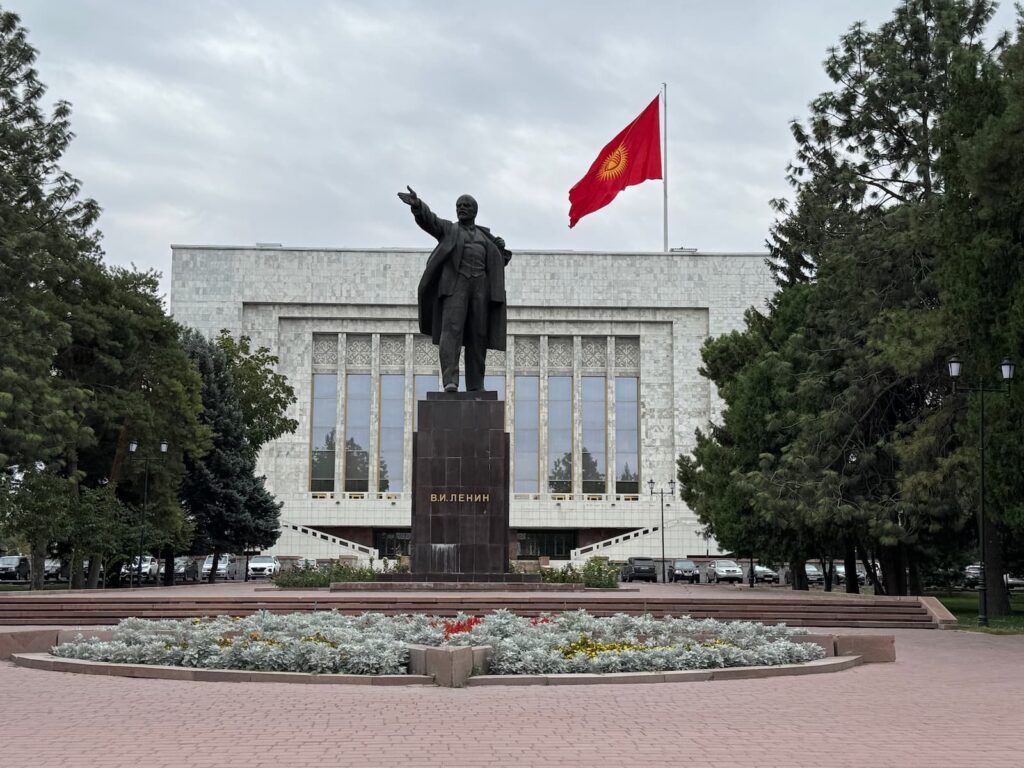
In the afternoon I did a self-guided tour of “Soviet Era Architecture, which was fascinating. Seeing the Lenin Statue, one of the few still left outside the former USSR, and standing in Ala-too Square, the site of protests during Kyrgyzstan’s turbulent political fight for freedom, offered a sobering reflection.
A reflection
For younger folks, the year Kazakhstan and Kyrgyzstan gained independence in 1991, is a distant date on the calendar. But for those of us born in the 1960s and 1970s, who came of age just as the Berlin Wall fell and the USSR crumbled, the freedom gained since 1991 feels more recent. We remember when these countries and their citizens were repressed behind an iron curtain, and in visiting them now, we can appreciate the progress.
Perhaps that’s what makes a Kazakhstan and Kyrgyzstan adventure so interesting to experience. Both countries are new to tourism, and they feel as yet, under explored. But their history is as rich and diverse as the Silk Road.